

The two wintering sea eagles are Steller’s (left) and the white-tailed. In addition to plumage differences, the size of their bills differs remarkably.
Last month I featured the elegance and beauty of the red-crowned cranes and whooper swans I photographed while leading two previous winter photo tours to Japan. I want to continue sharing images from those remarkable trips so this month I will focus on the two species of majestic eagles I was able to observe and photograph: Steller’s sea eagle and the white-tailed eagle.
Both the Steller’s and white-tailed eagles are fish-eating raptors which nest in Russia and then migrate to northern Japan in winter. In the 1970s and 80s, during the heyday of the pollock fishery, many of these eagles overwintered in northeastern Hokkaido, thriving on the wastes discarded by the fishing boats. Regrettably, yet predictably, decades of overfishing by Russian, American, Chinese, Taiwanese, and Japanese boats, eventually led to the collapse of the fishery, and as a result, the wintering eagles began to move elsewhere. Enterprising local fishermen quickly realized they could boost their waning income by taking tourists and photographers out to the ice edge where they could lure the unwary eagles close to their boats by tossing out frozen herring, much to the delight of all their passengers.
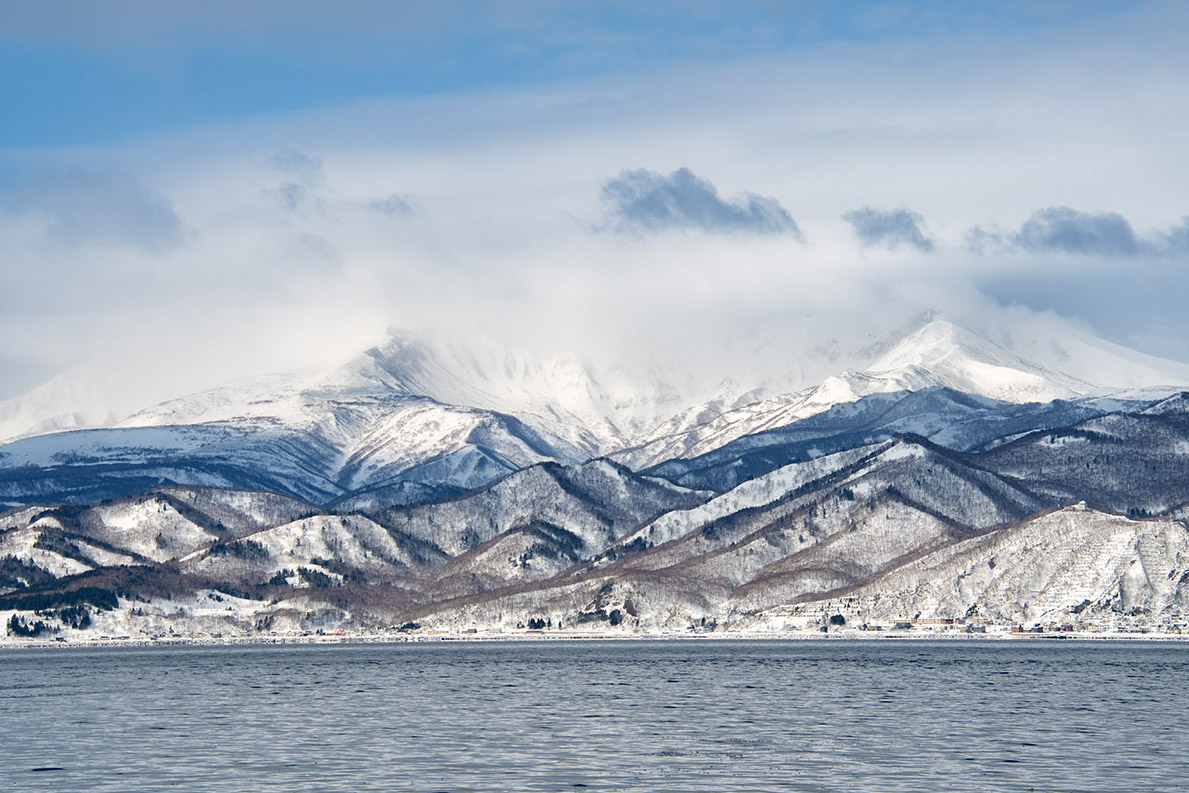
The small coastal fishing town of Rausu is nestled beneath the mountains of Shiretoko National Park in Hokkaido.
On my photo tours we were based in the small fishing village of Rausu. During each tour, we made several trips out to the ice edge to photograph the eagles. Each day, once we reached the ice, the fishermen began tossing out herring, and seemingly from nowhere, dozens of eagles were suddenly flying around our boat. I can honestly say I was overwhelmed by seeing so many of these magnificent raptors so close at hand. On top of that, I was amazed by the variety of behaviour I witnessed.
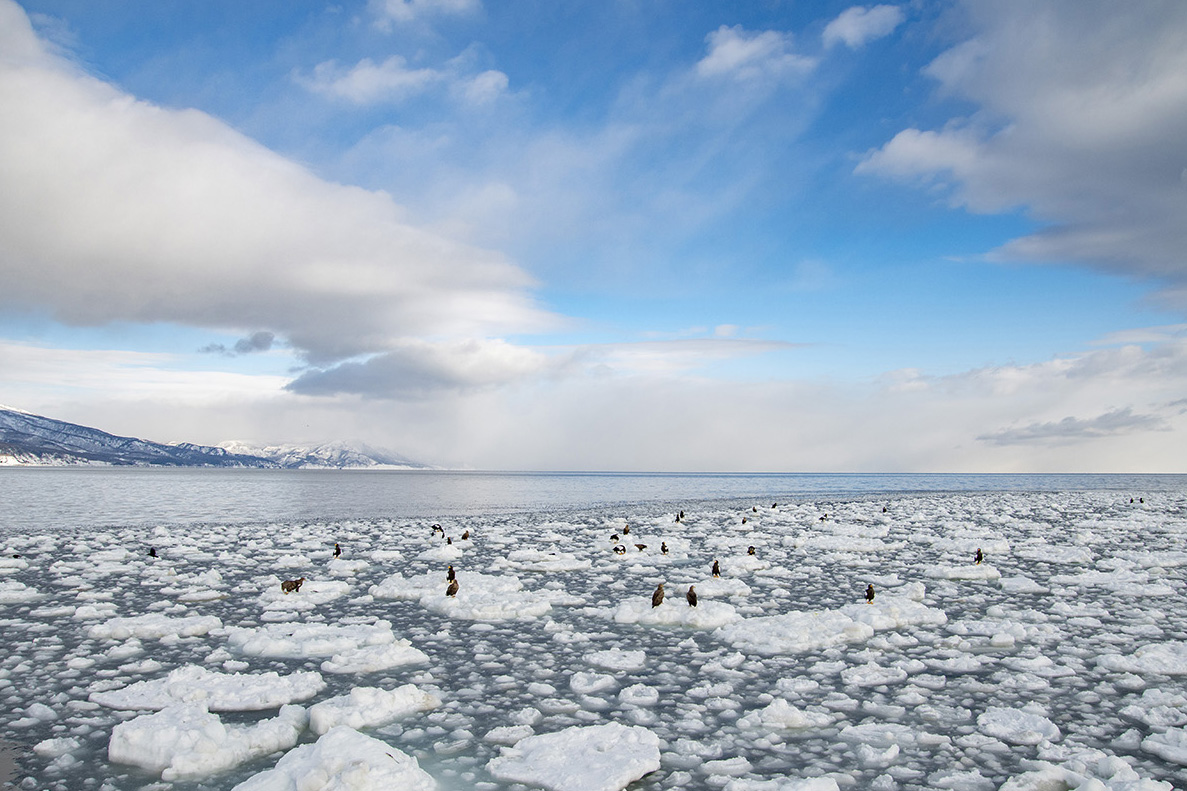
Several dozen sea eagles, mostly Steller’s, rest on the sea ice.
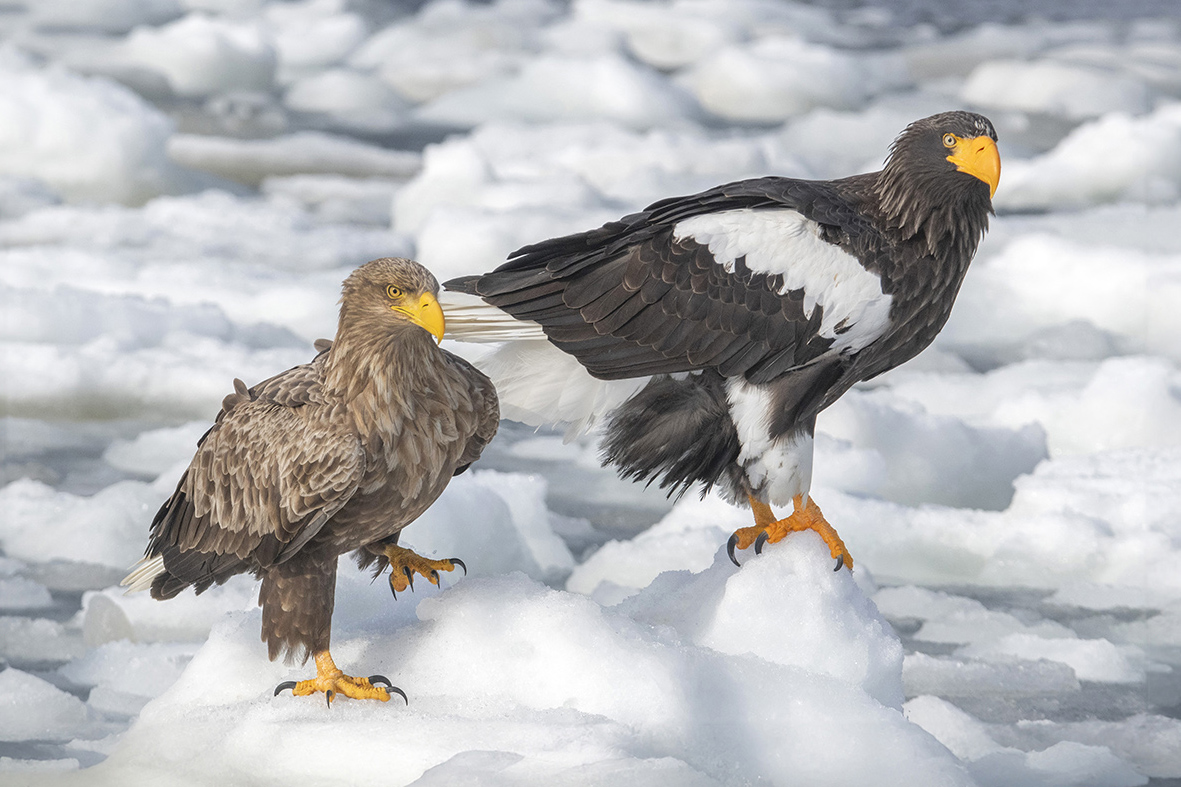
The size difference between the two species is most apparent when they are seen side by side in the same photograph. In all species of eagles, the females are larger than the males. A large female Steller’s sea eagle can weigh up to 7.8 kilograms (17 lbs), which is marginally heavier than the legendary harpy eagle of the Amazon rainforests, making Steller’s the heaviest eagle in the world. The white-tailed eagle is a relative lightweight tipping the scales at an average weight of 4.8 kilograms (10 ½ lbs).
The Steller’s sea eagle is named in honour of George Wilhelm Steller who was the naturalist/surgeon on Vitus Bering’s final Russian voyage of discovery launched in 1740. The expedition originally planned to explore and map the coast of Alaska but ultimately spent just 10 hours on Kayak Island off the western coast of Alaska. Steller is credited with being one of the first Europeans to set foot on Alaskan soil. On the voyage he discovered a jay, an eider, a sea eagle, a sea lion, and a sea cow, all of which now bear his name.
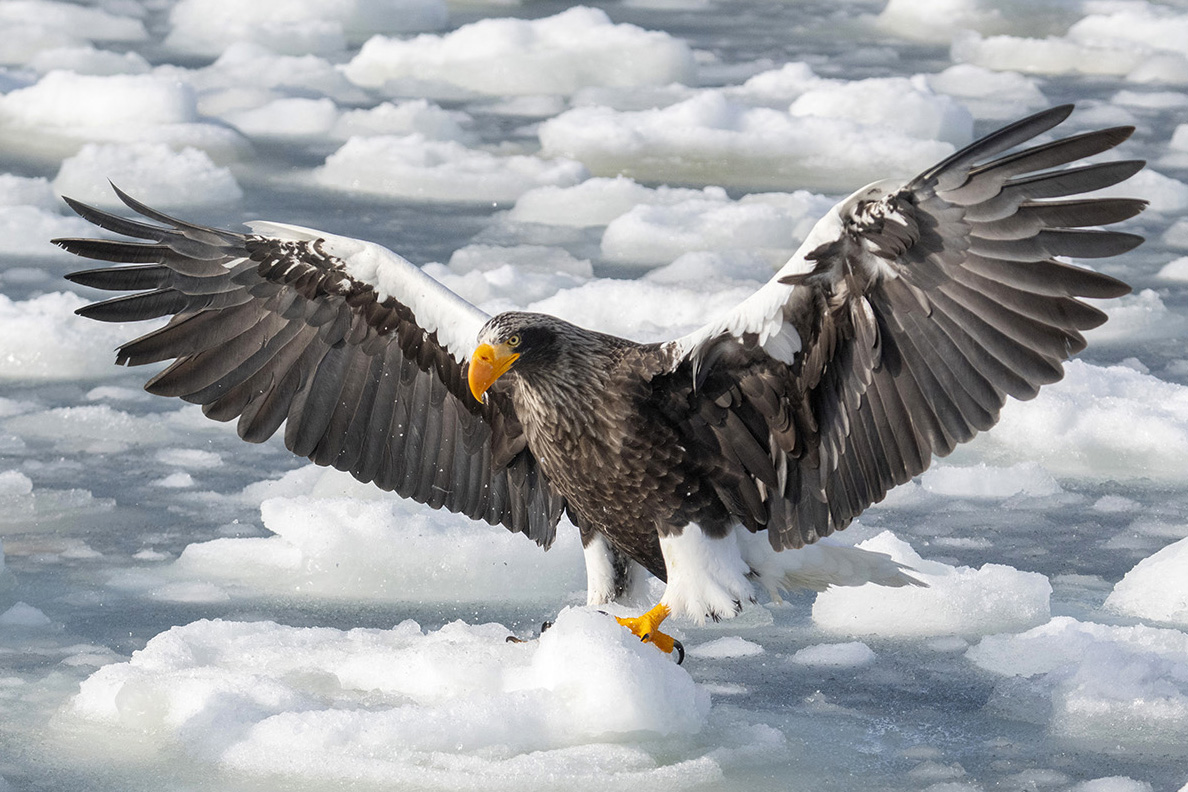
Steller’s sea eagles have a wingspan up to 2.5 meters (8 ft 2 in).
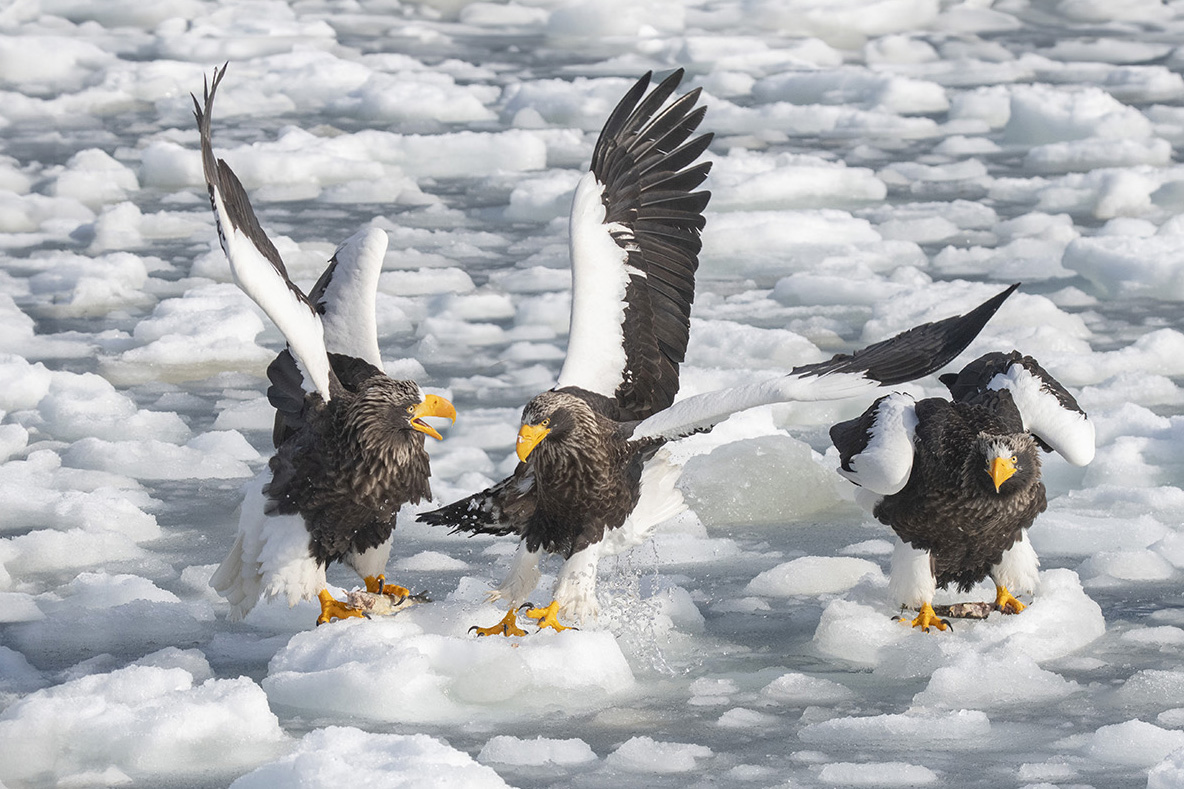
The Steller’s sea eagle is a threatened species numbering less than 4,000. They nest around the entire perimeter of the Sea of Okhotsk in far eastern Russia and overwinter in China, the Korean Peninsula and northern Japan.
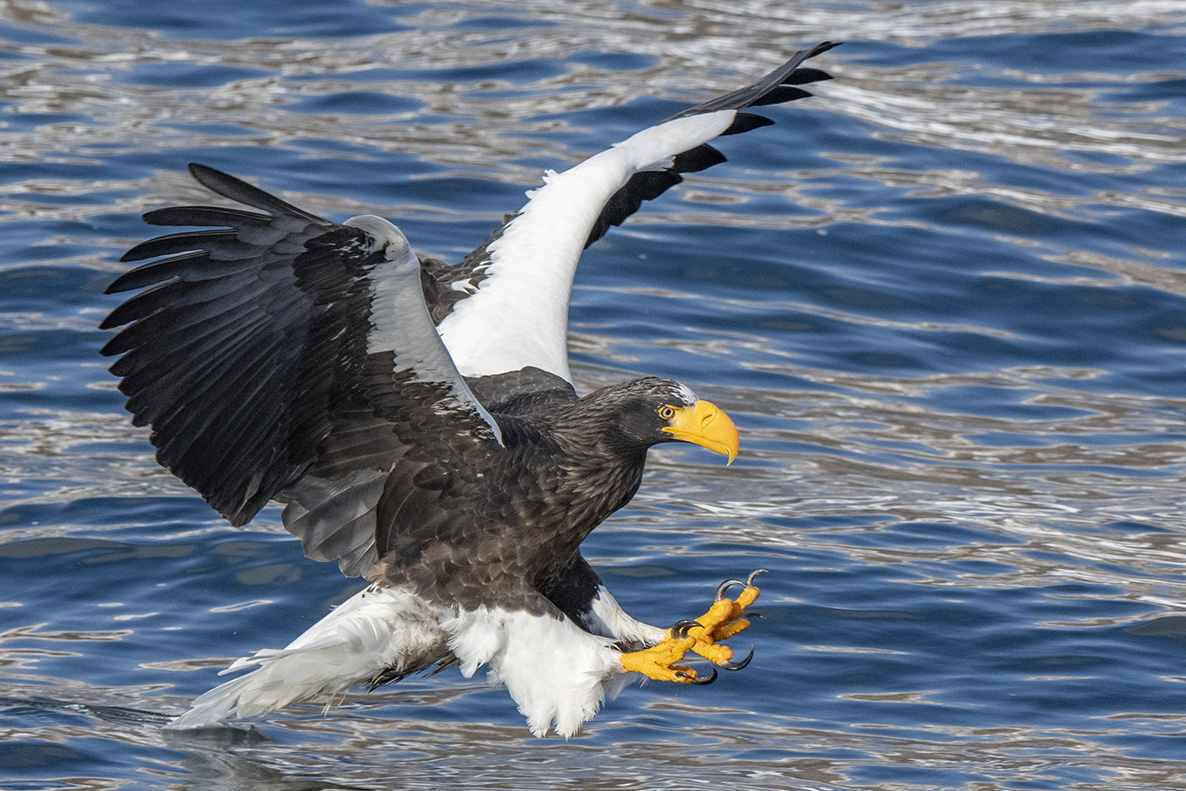
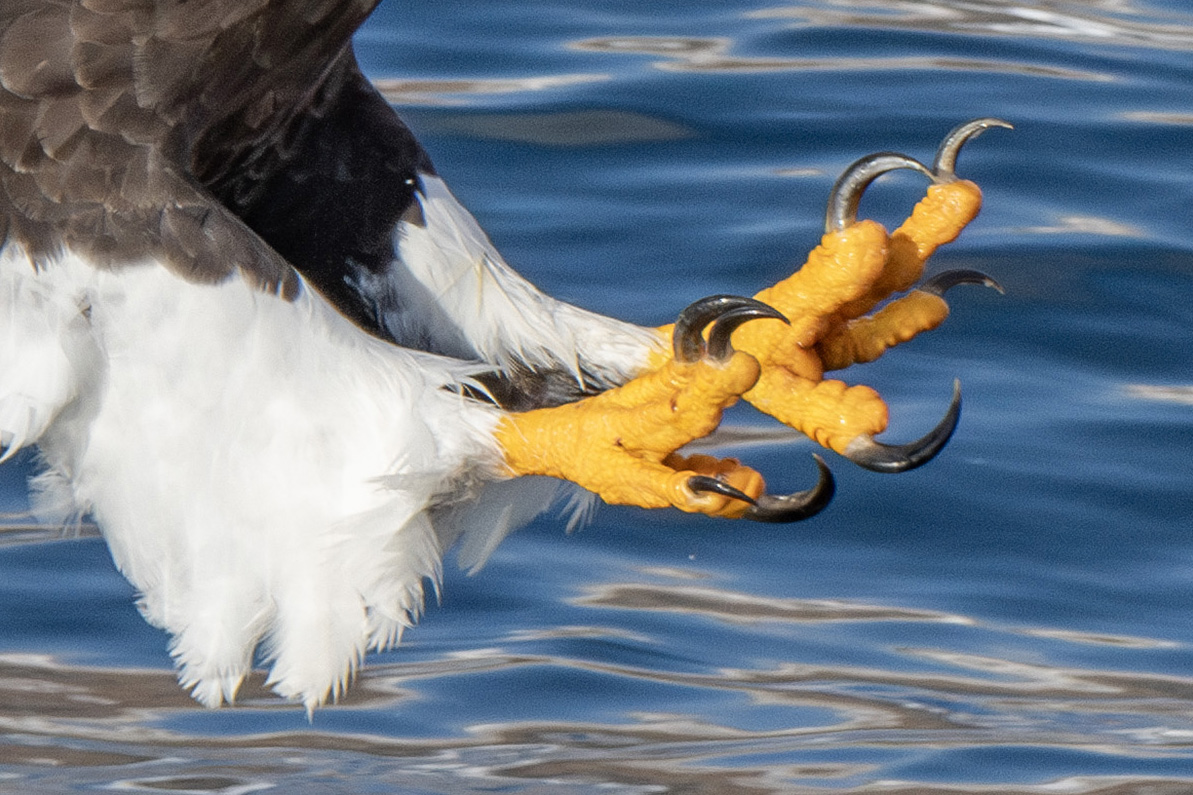
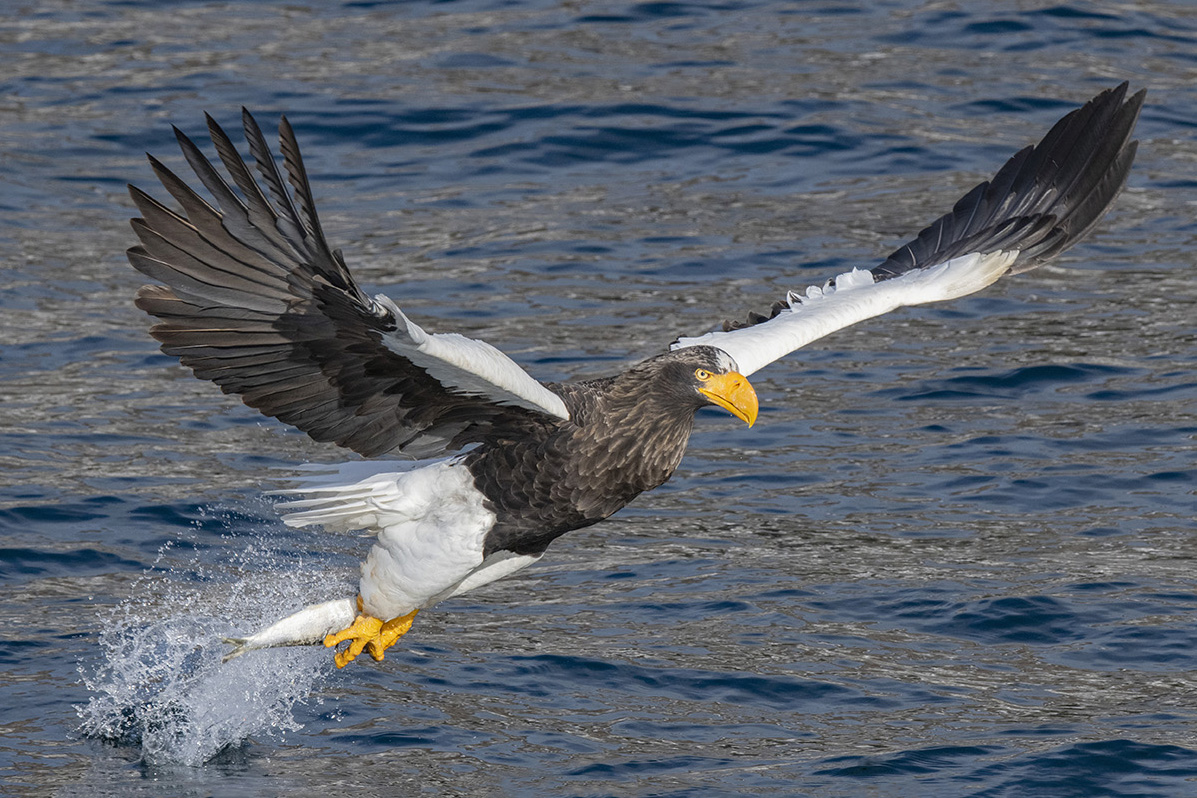
All sea eagles have relatively short toes, long, strongly curved talons, and roughened bottoms on their feet, necessary adaptations for catching and holding slippery fish.
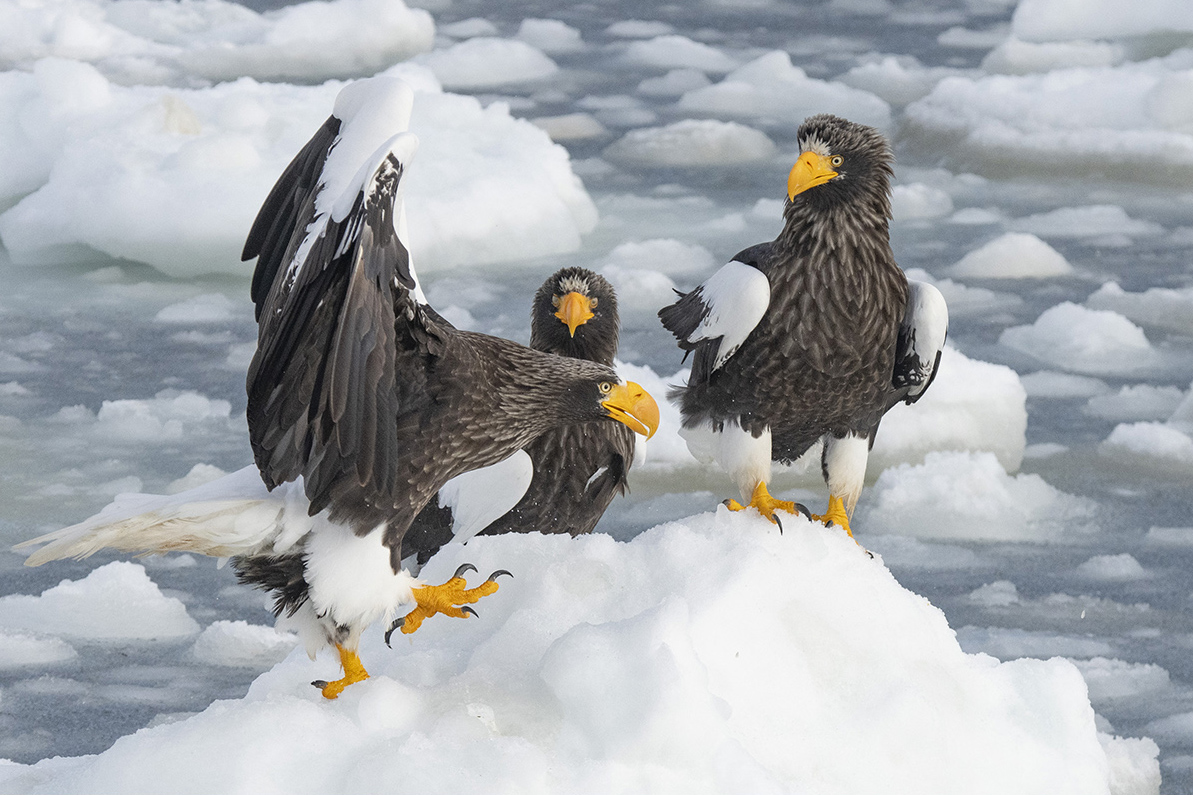
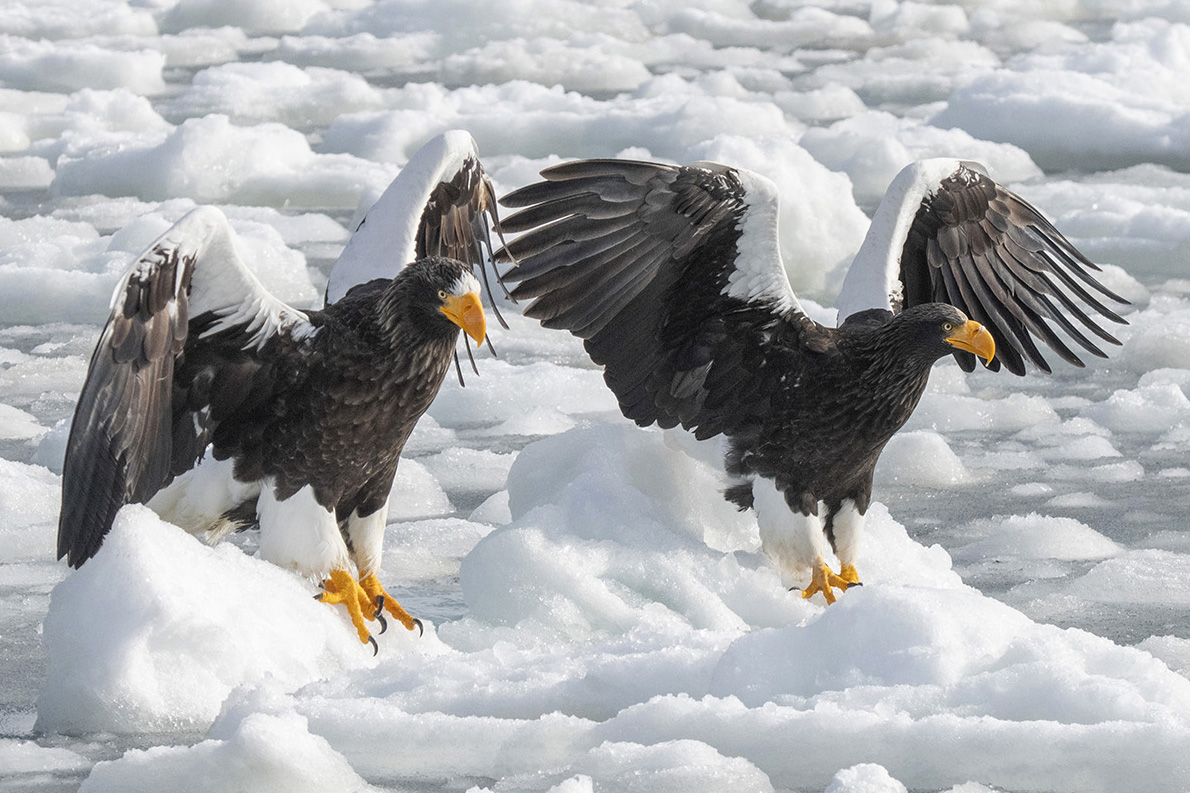
Eagles don’t normally aggregate as densely as this unless there is a surplus of food. In such circumstances they rarely fight as the risk of injury is too great and they limit their behaviour to vocal and postural displays. The raised feathers on the crown of the eagle on the right indicates it is agitated by the bird landing in front of it.
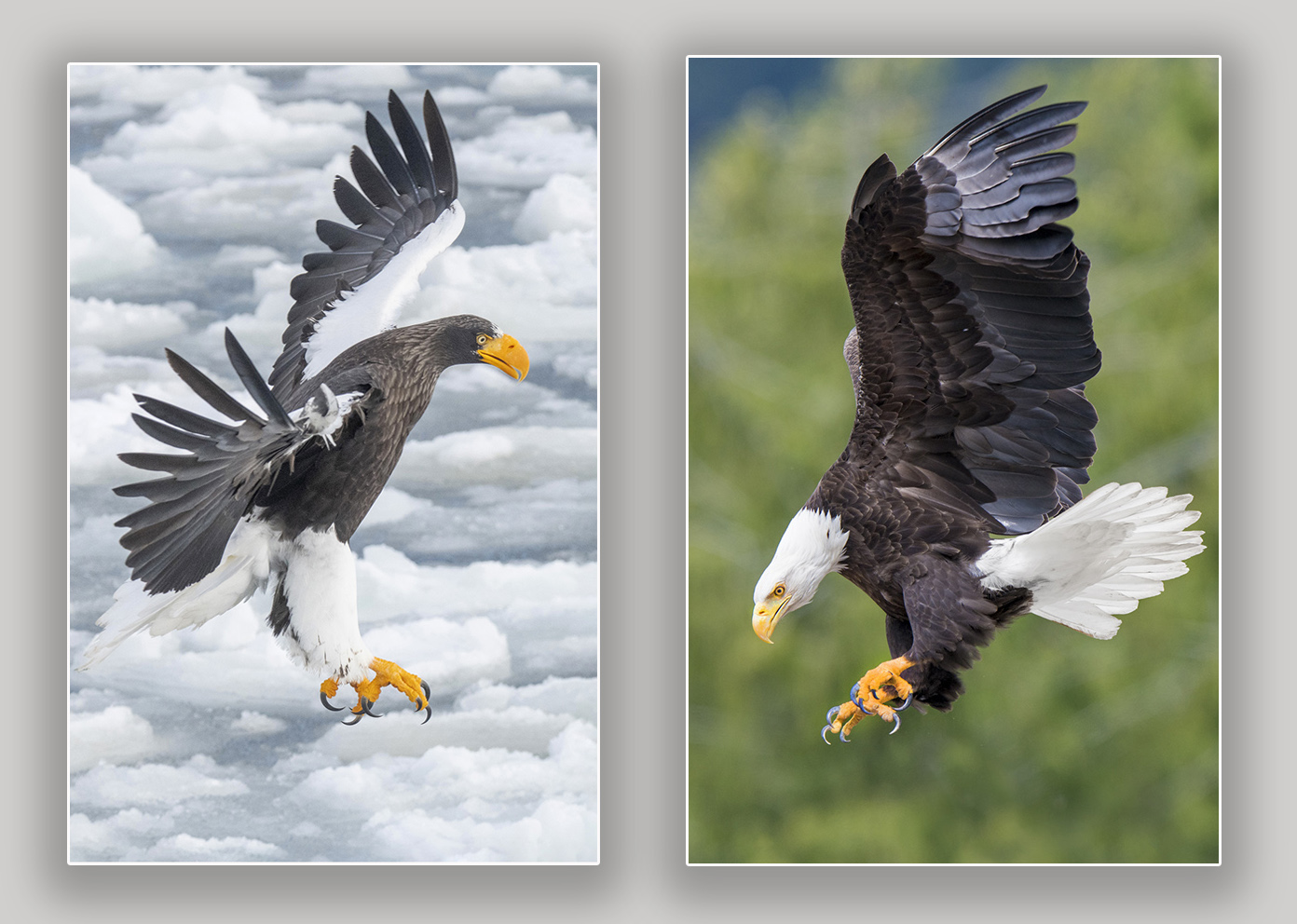
Worldwide, there are ten species of sea eagles, also known as fish eagles, with at least one species occurring on every continent except Antarctica and South America. The bald eagle of North America, pictured on the right, is one of the sea eagles and is one of the Steller’s closest relatives. Both have yellow beaks, feet, and eyes.
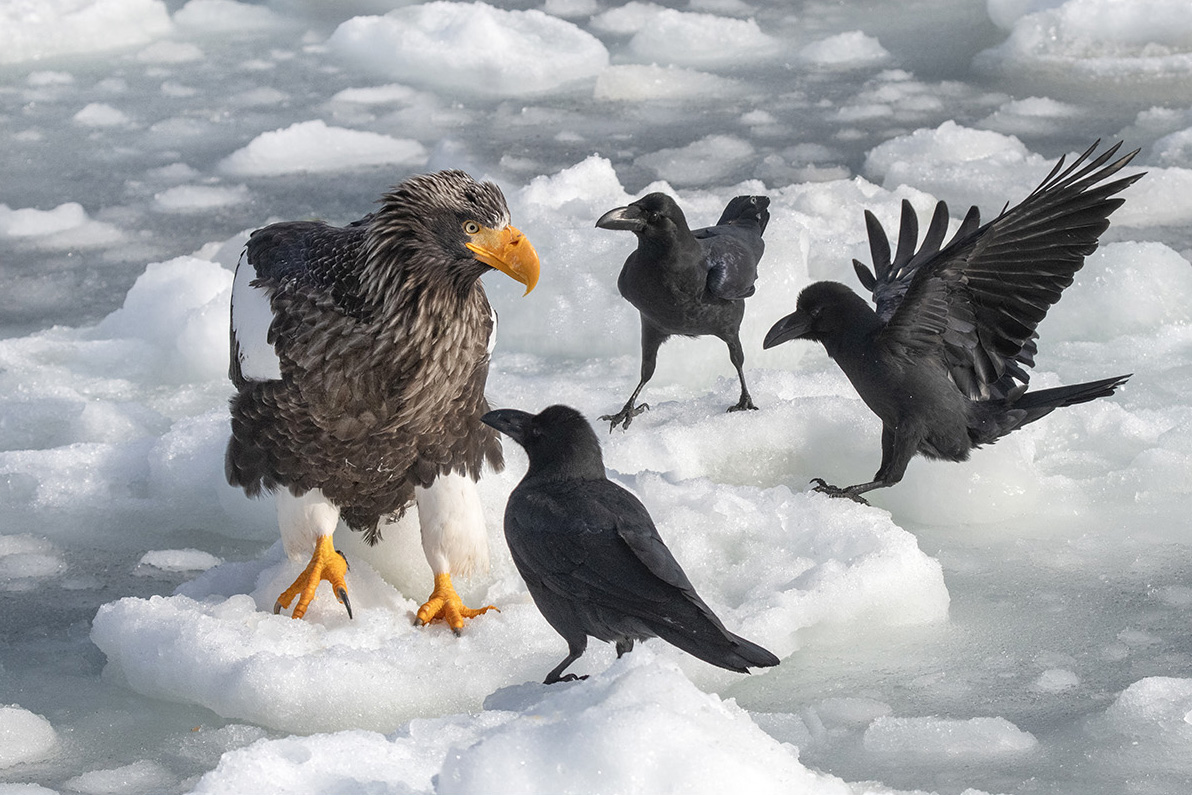
The large-billed crow is primarily a scavenger that sometimes gangs up to attack and chase other birds, especially raptors.
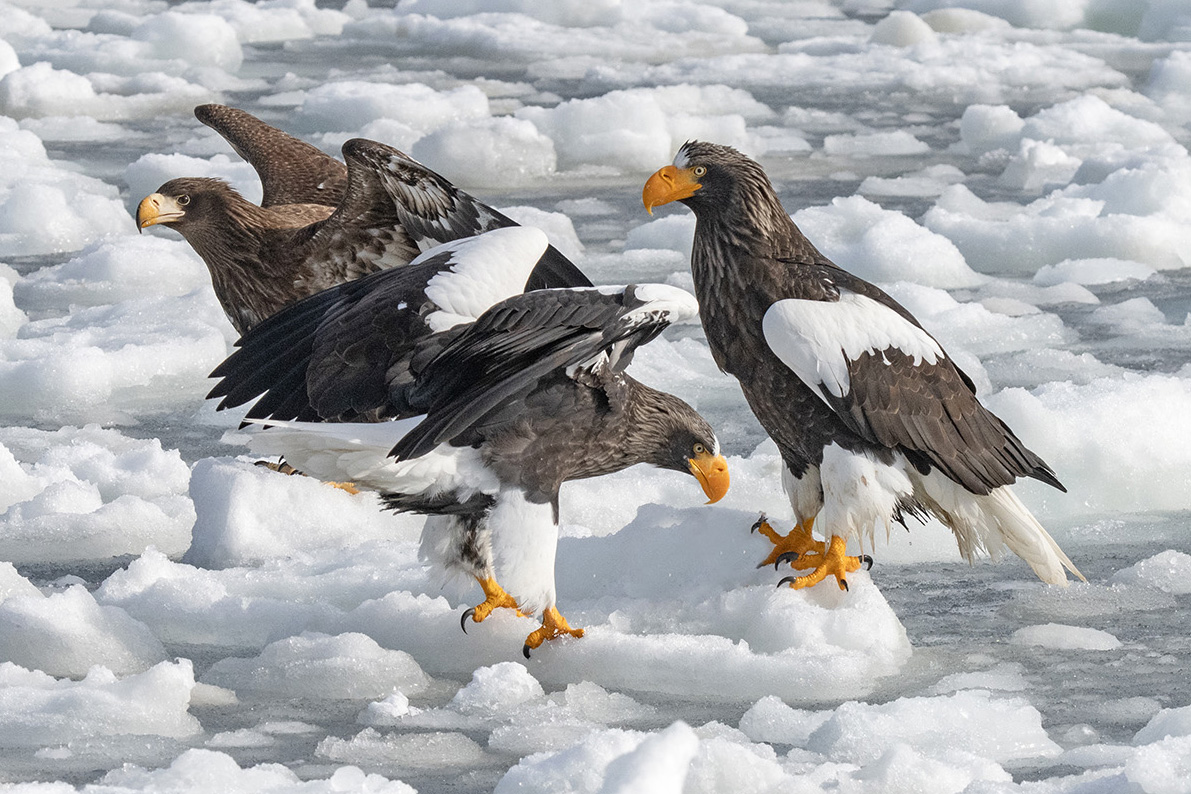
The all-brown bird in the background is a juvenile Steller’s. Its large beak distinguishes it from a juvenile white-tailed eagle which also has all brown plumage. Like many eagles, Steller’s don’t acquire full adult plumage until they are five to six years old.
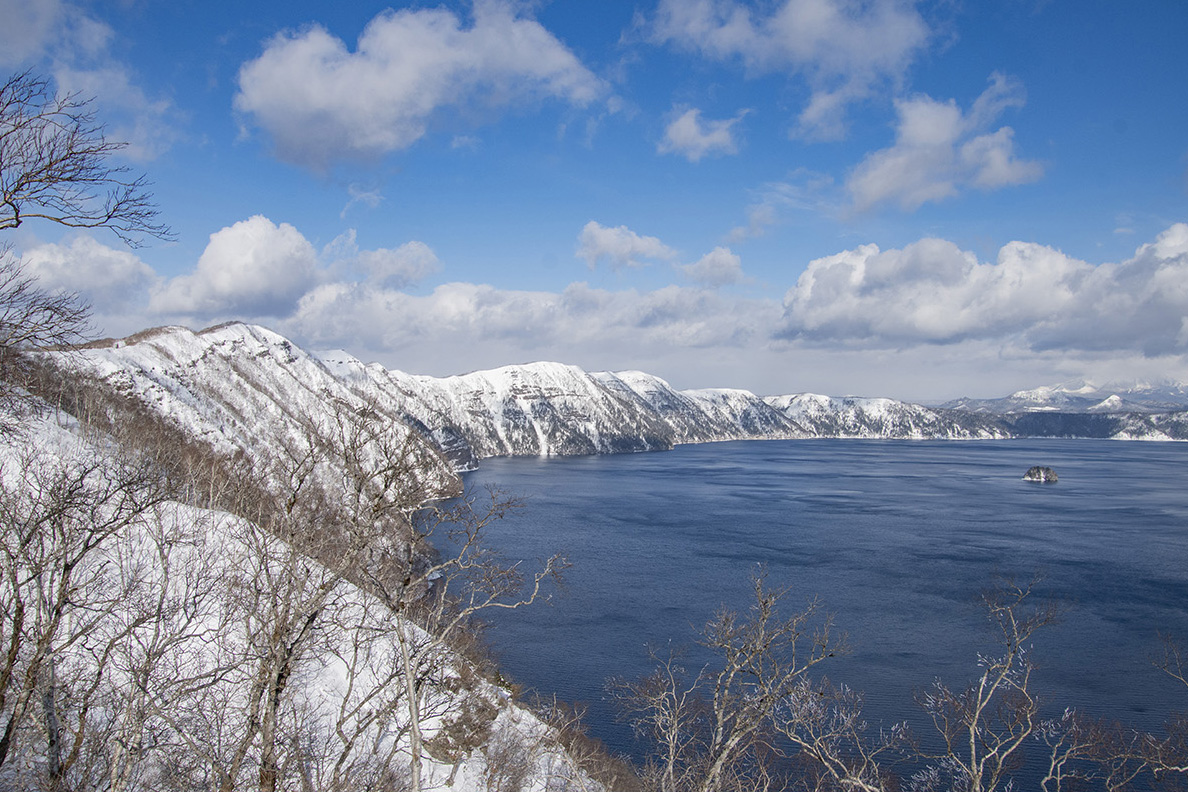
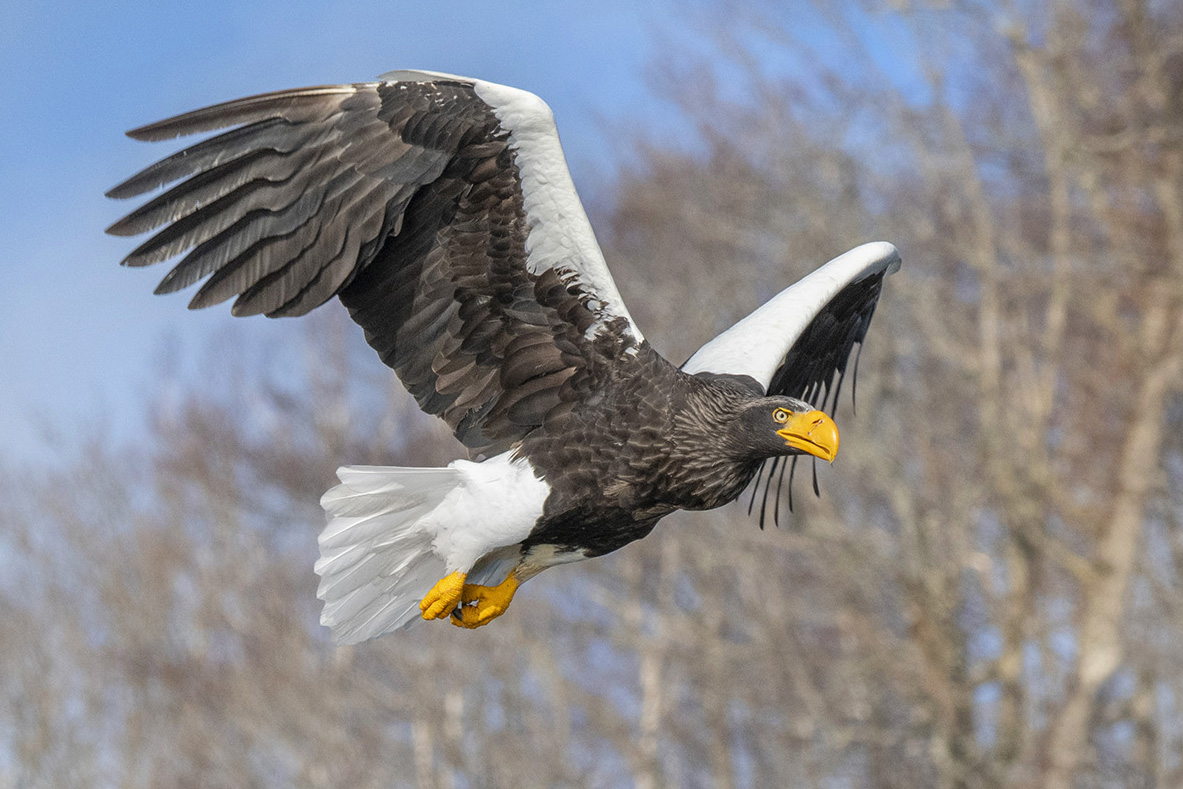
I saw my first Steller’s sea eagle as it soared over the treetops along the shoreline of Lake Mashu, a flooded caldera. On Hokkaido, some Steller’s sea eagles spend the winter inland from the coast hunting waterfowl, grouse, pheasants, and cranes, as well as scavenging the carcasses of winter-killed sika deer.
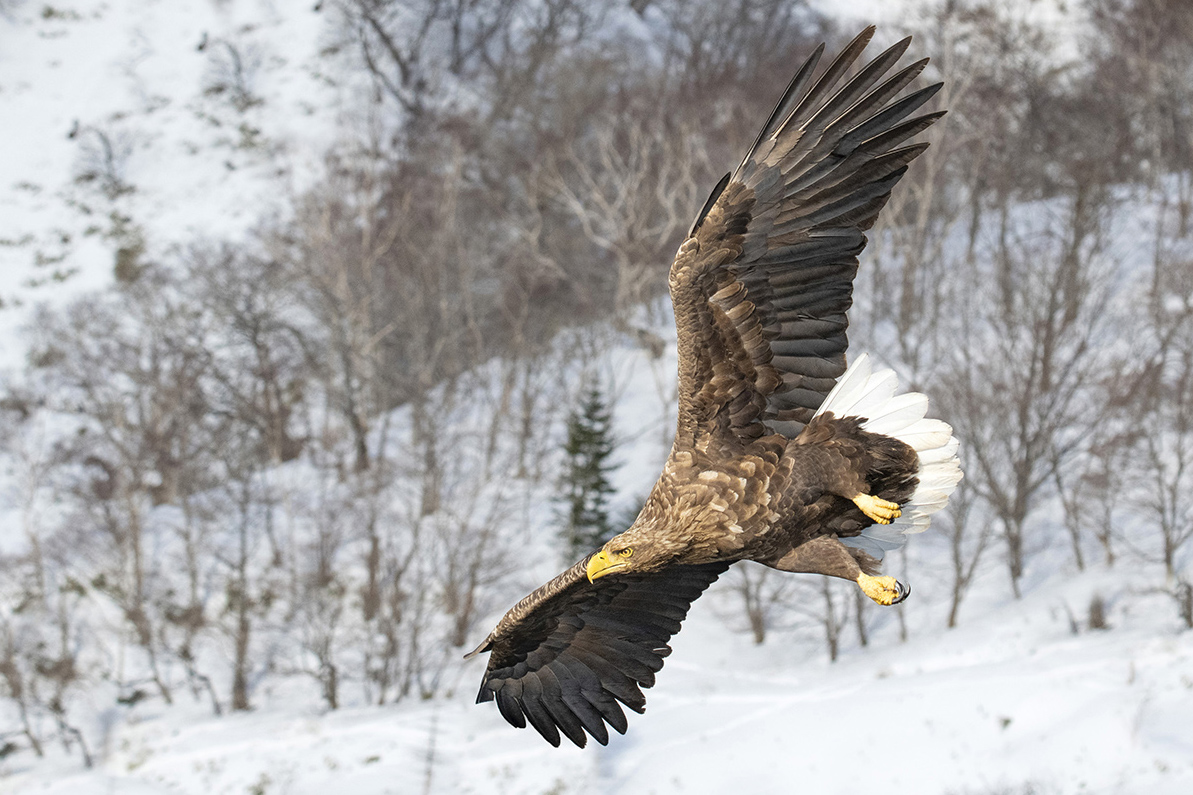
The white-tailed eagle has the largest range of the world’s ten sea eagles, extending from Greenland in the west to Russia’s Kamchatka Peninsula in the east.
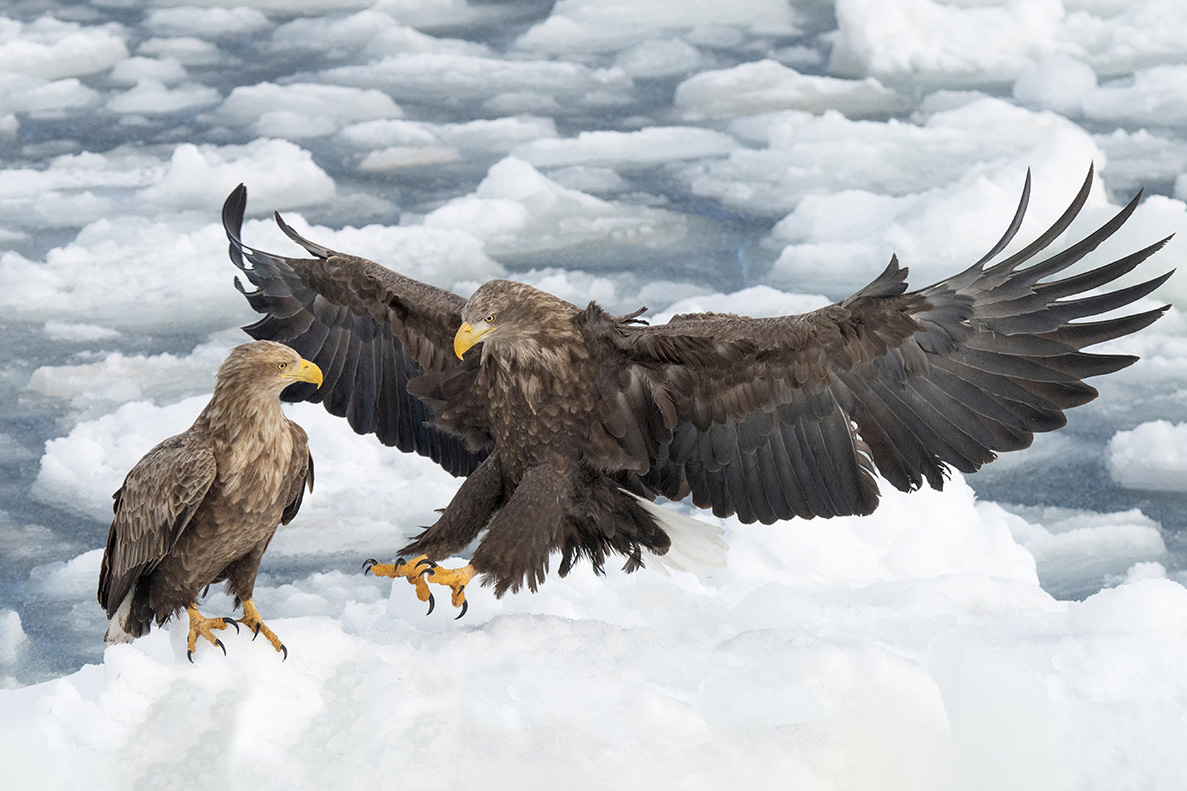
The average wingspan is 2.3 m (7.5 ft). Although the maximum wingspan on a Steller’s is larger, their average wingspan is less than the whitetail’s.
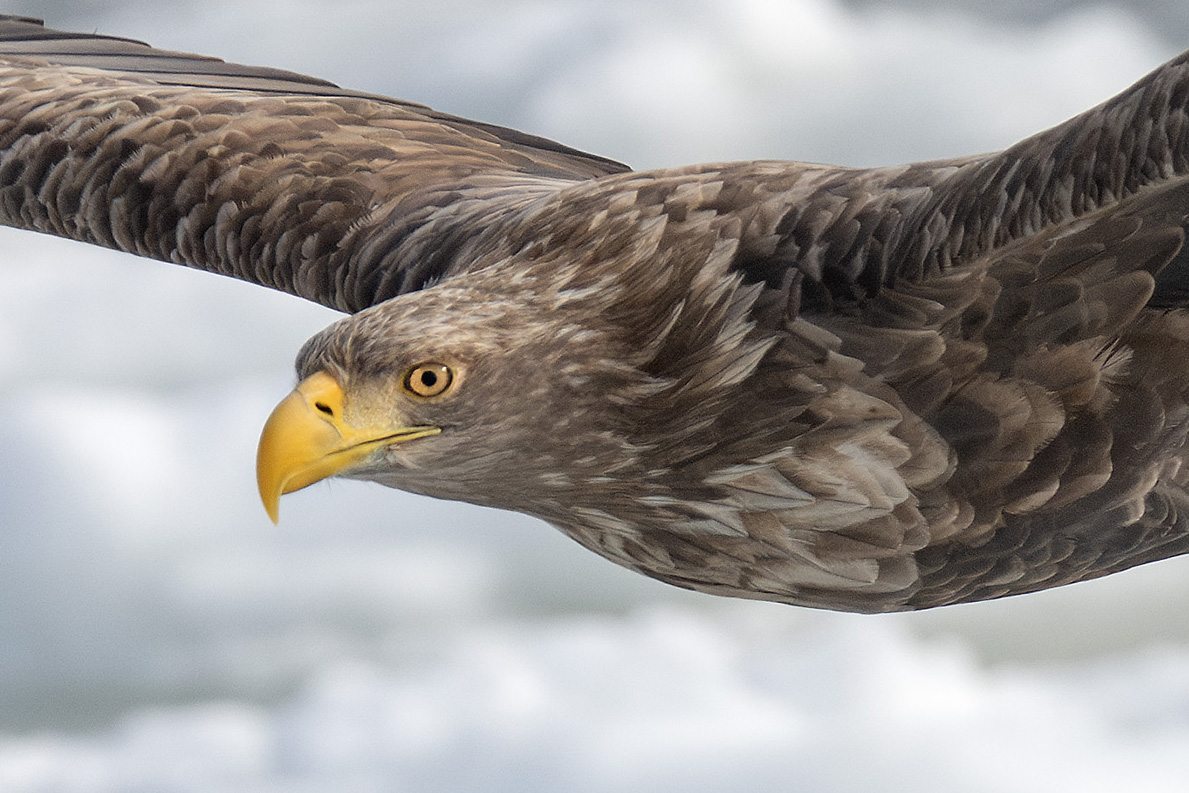
Based on the density of photosensitive cones in the retina, the visual acuity of most eagles is just two to three times greater than that of humans.
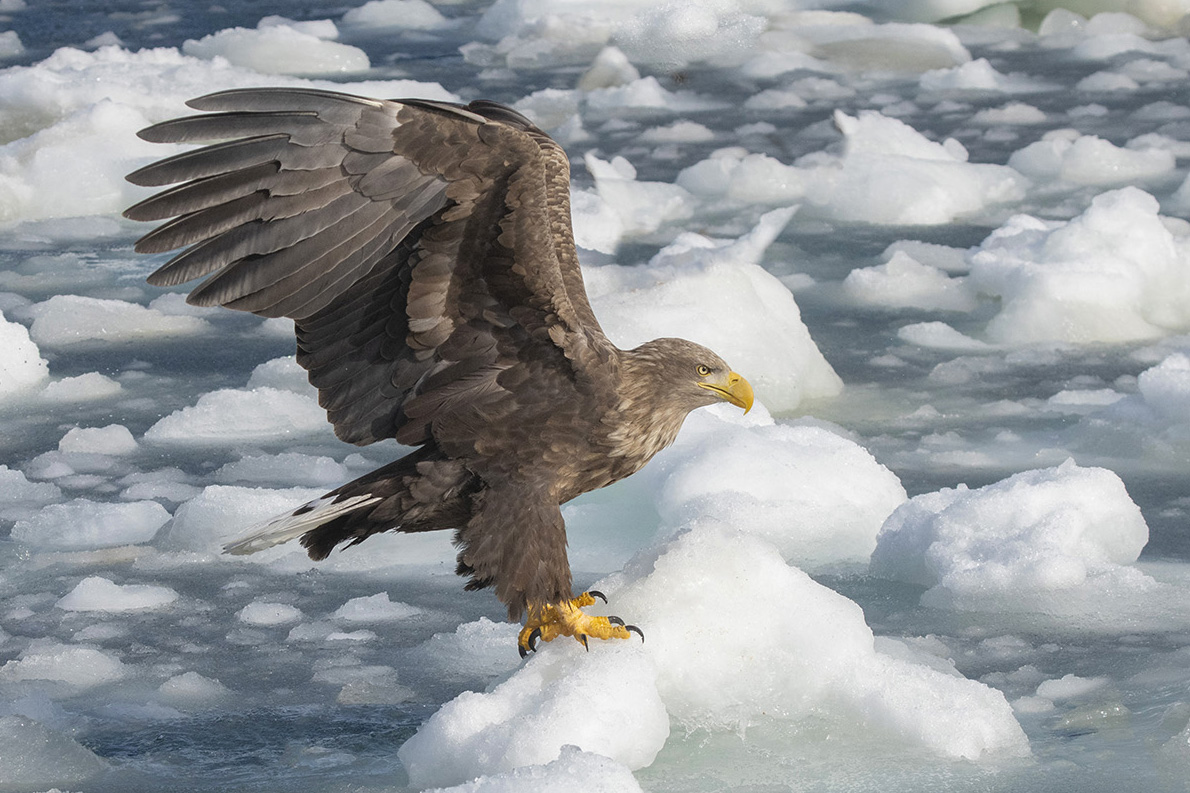
When this white-tailed eagle landed on an unstable piece of sea ice it rolled, and the eagle almost fell into the water.
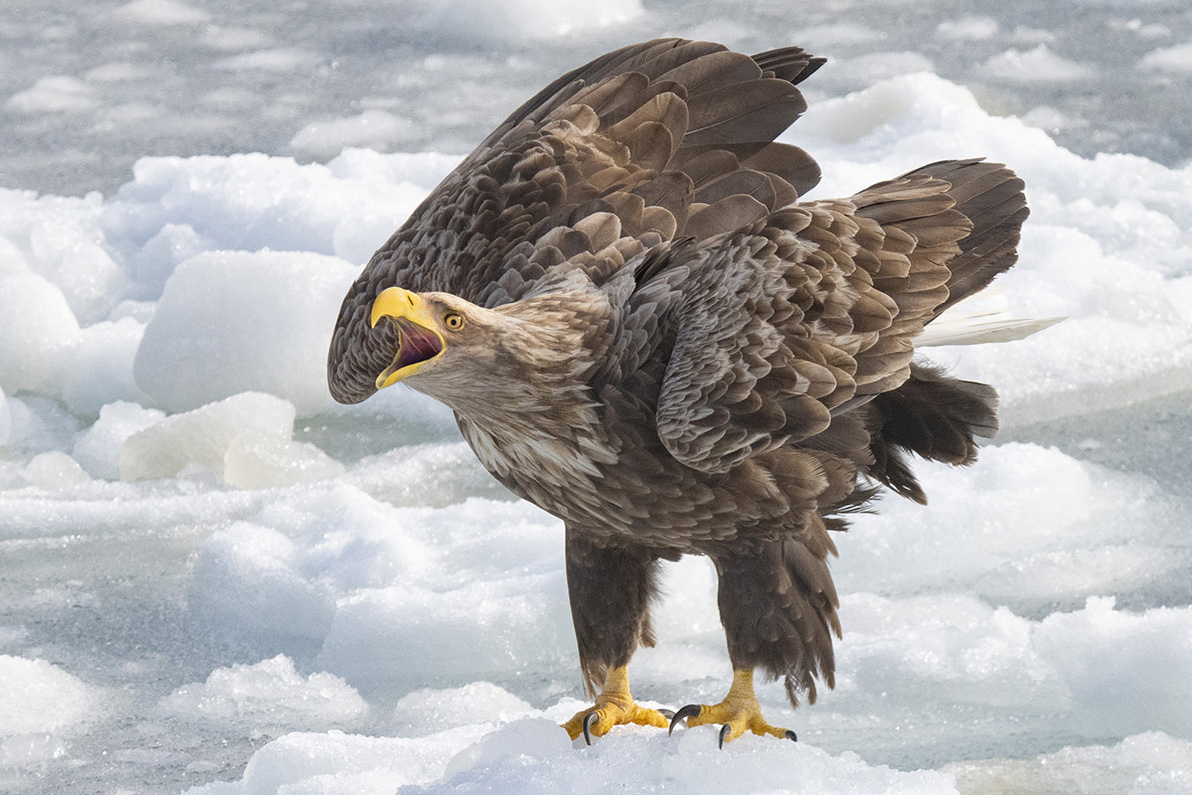
I don’t know why this eagle was vocalizing so energetically because there were no other eagles nearby.
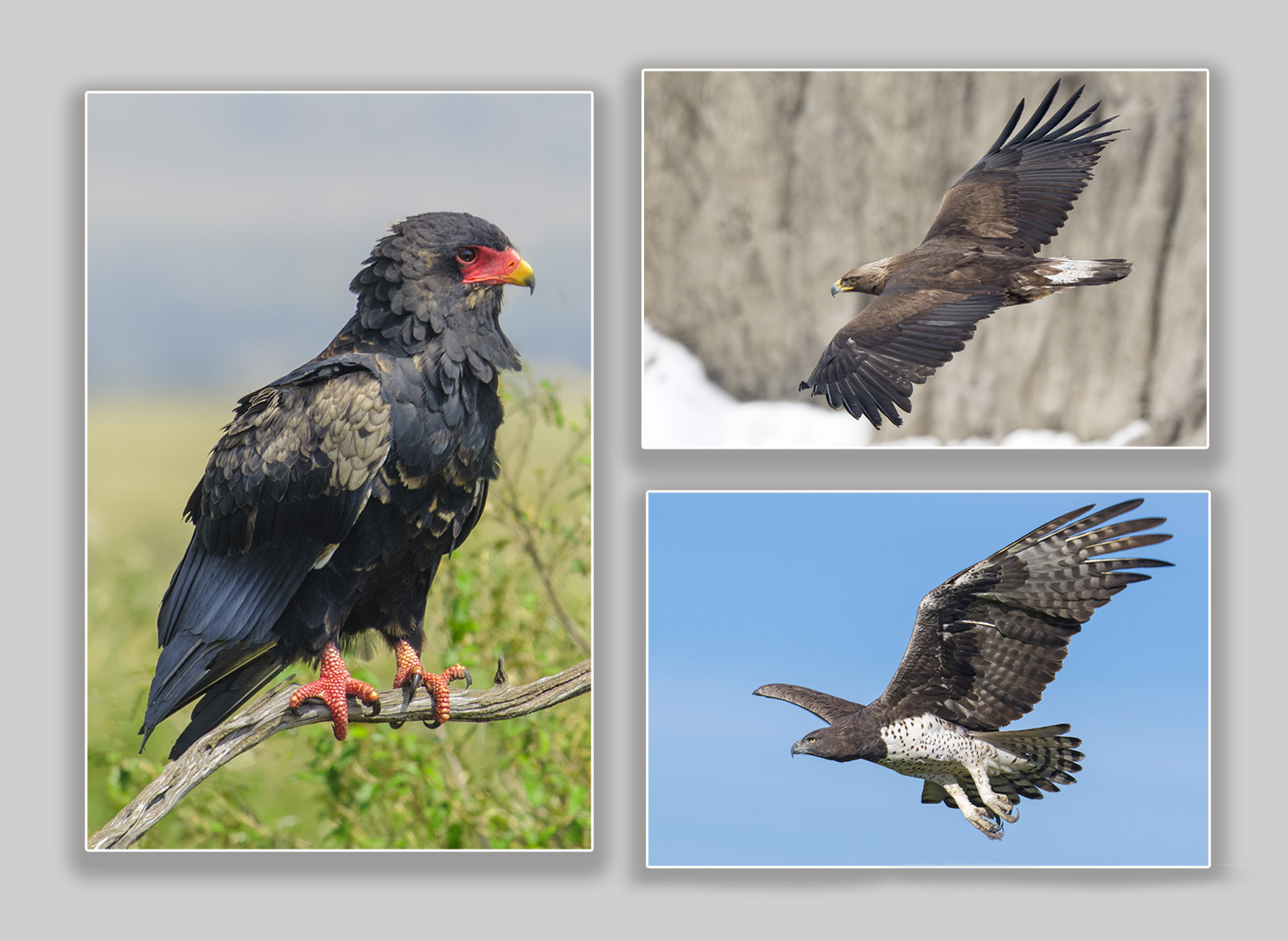
Worldwide, there are an estimated 68 species of eagles which are informally broken into four groups. They include the sea eagles, which we have discussed, the snake eagles, represented here by the bateleur eagle of Africa on the left, the booted eagles, represented by the golden eagle in the upper right, and the giant forest eagles, represented by the martial eagle in the lower right.
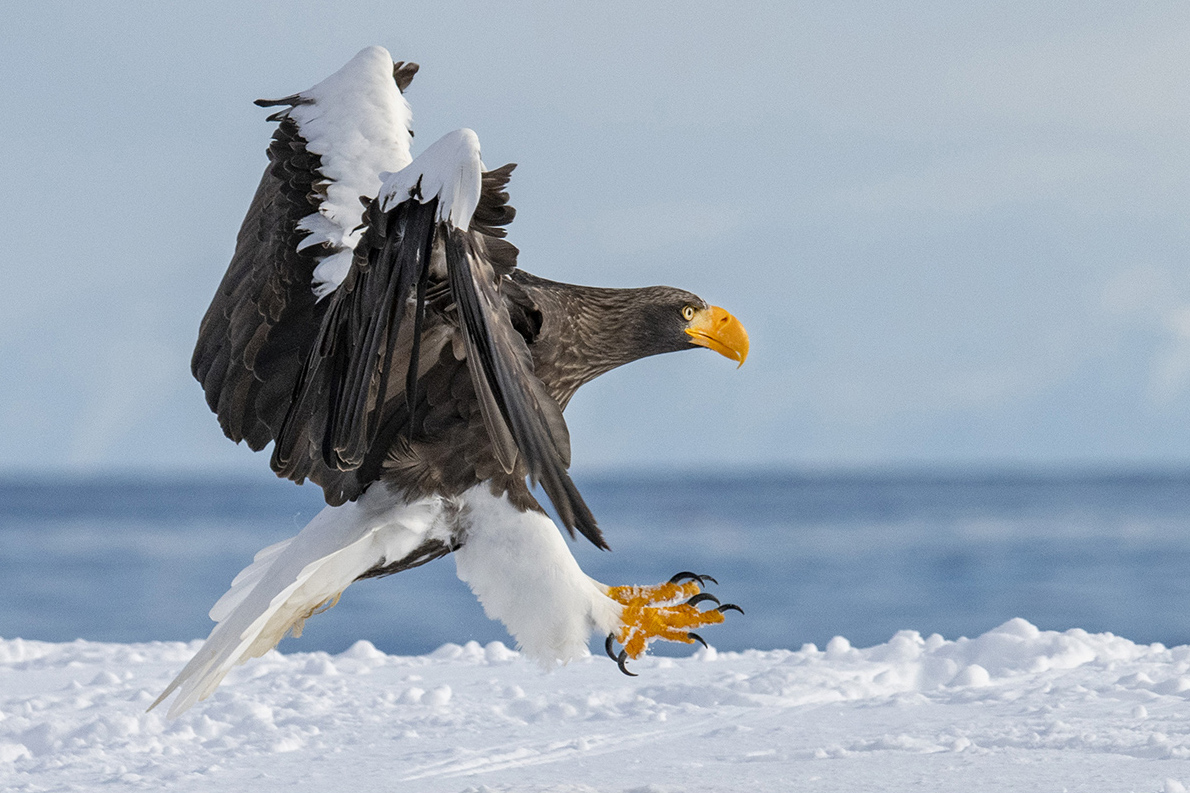
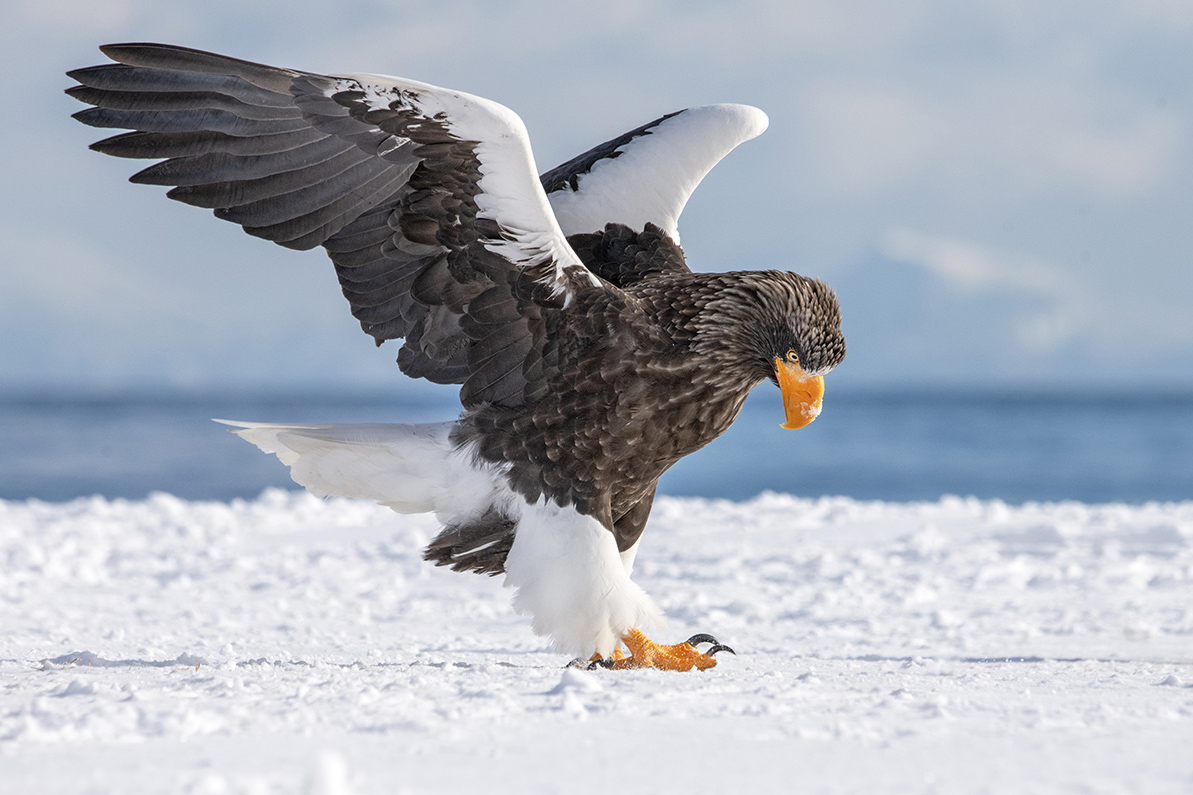
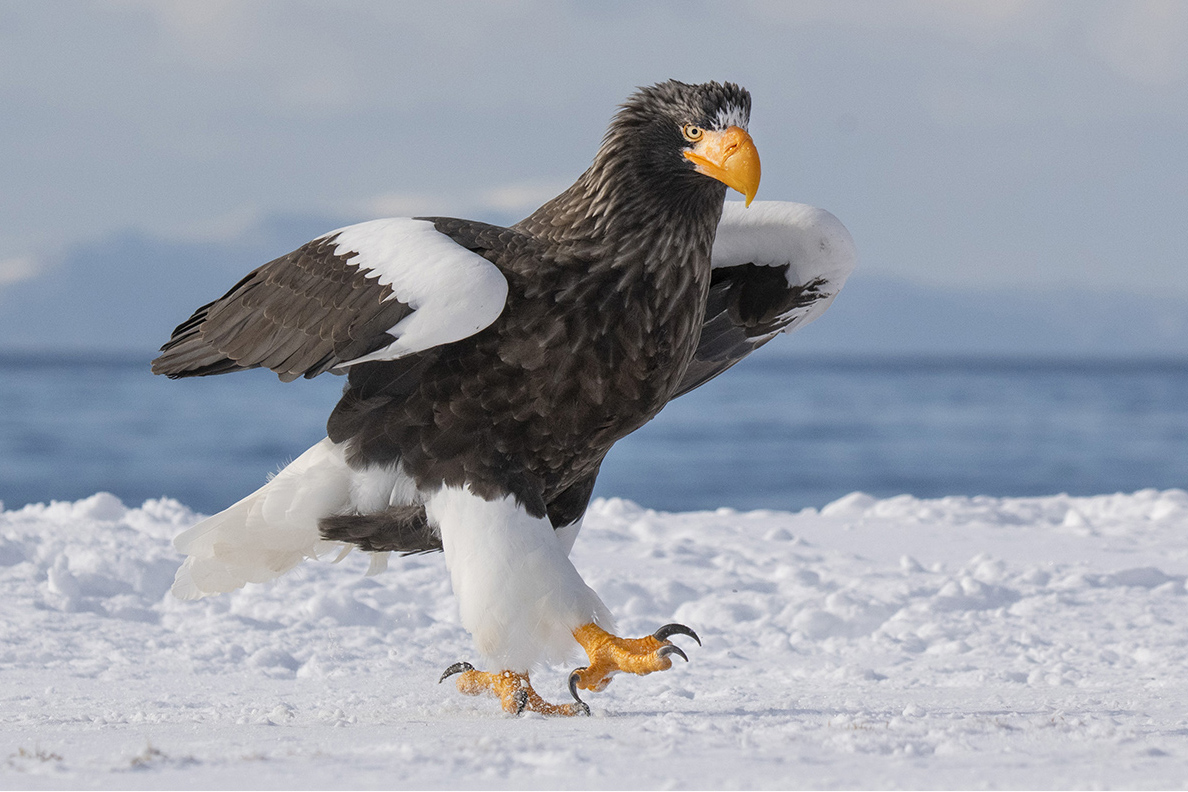
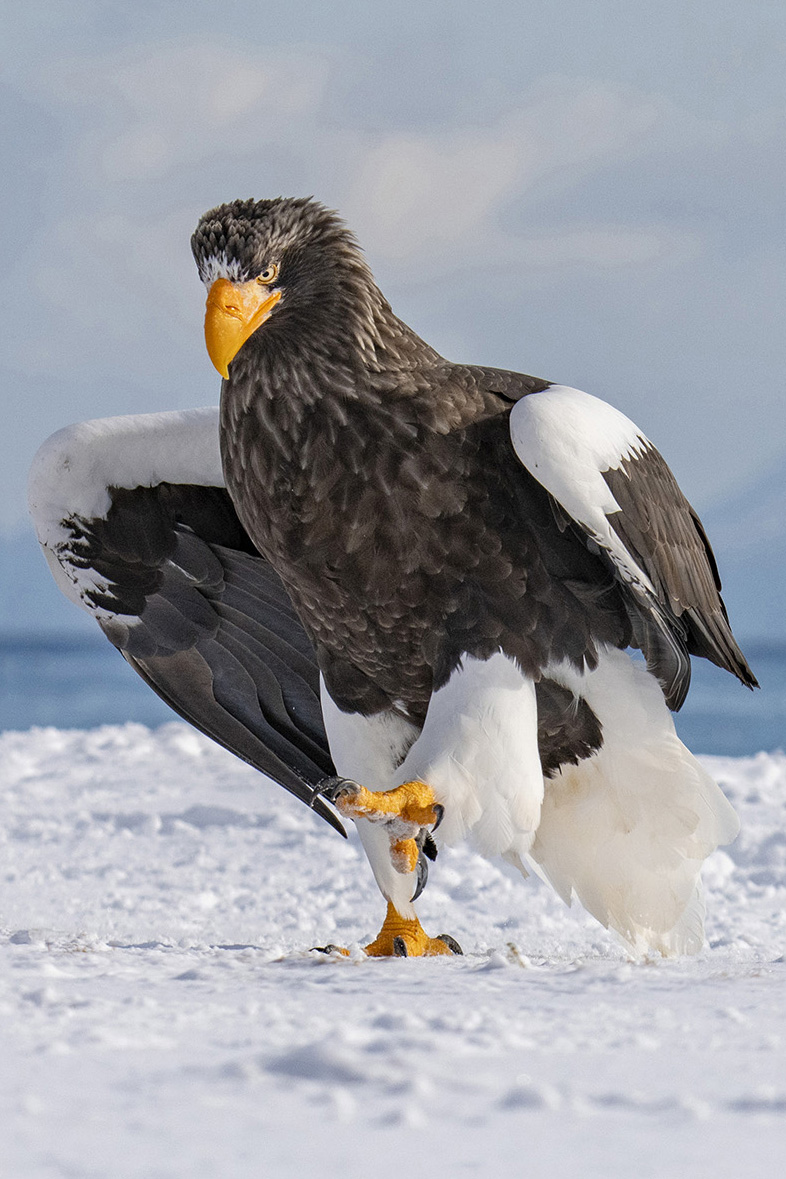
It was a rare opportunity to photograph the eagles from a low angle as they strutted on the snow-covered ground and resulted in images that were different from most of those I have made of other birds of prey.
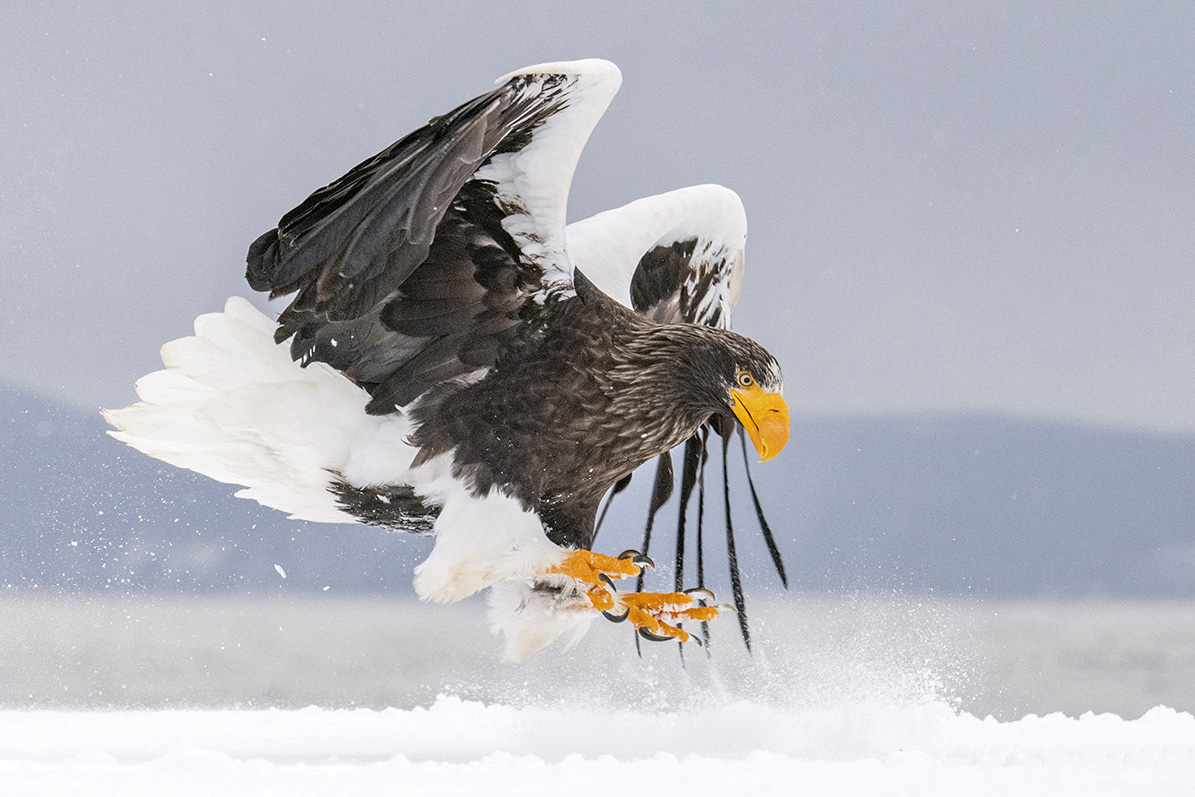
I don’t know why this eagle suddenly jumped up in alarm. It landed immediately afterwards and resumed strutting about.
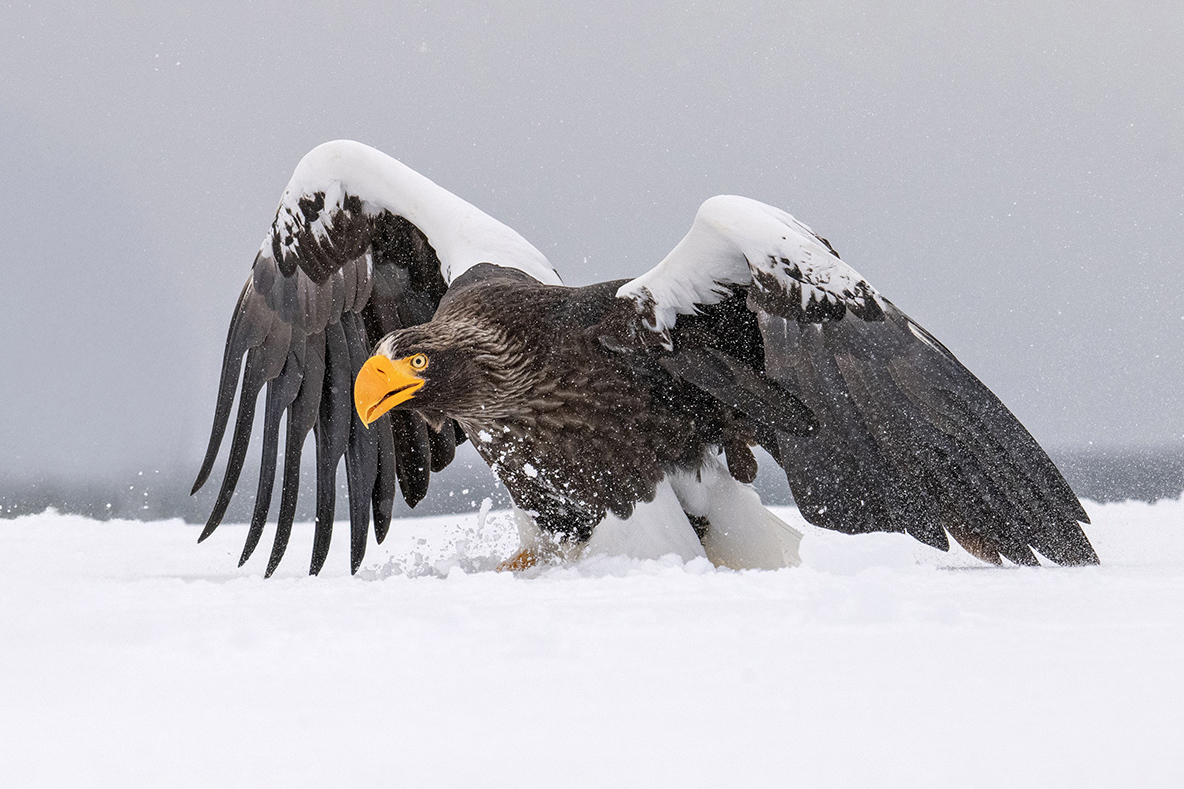
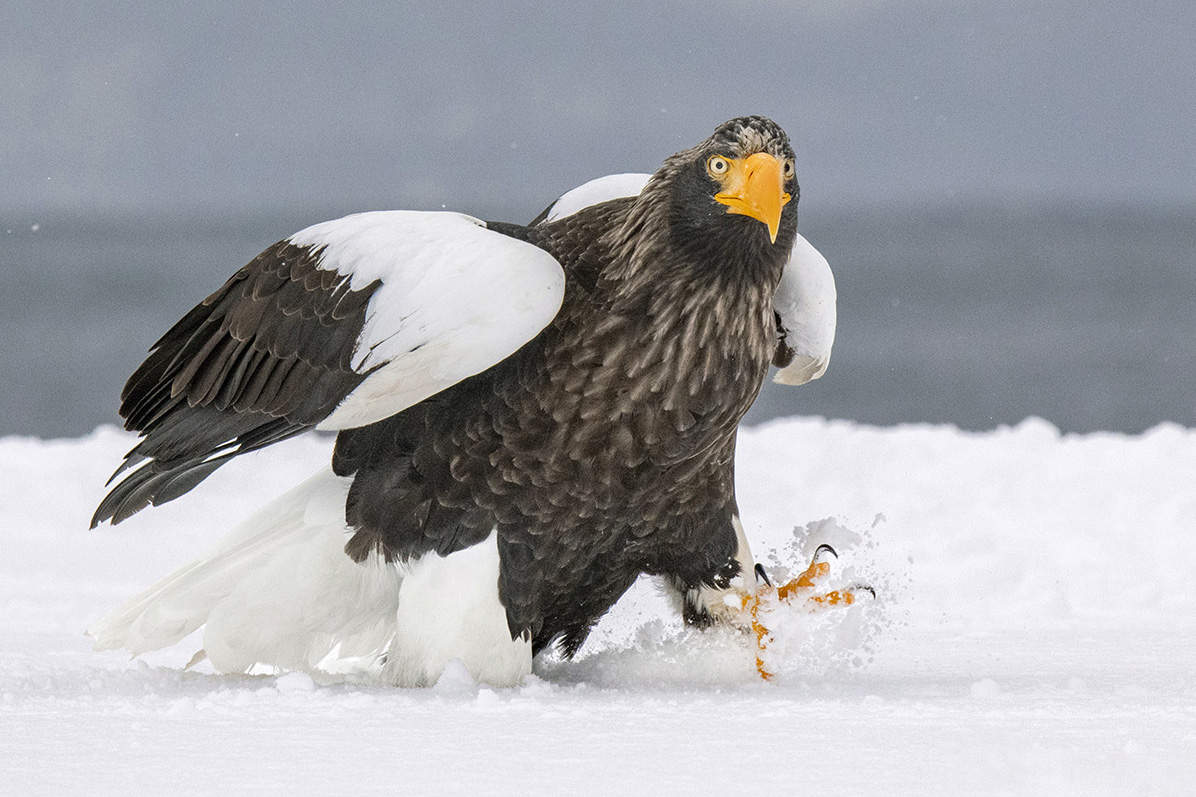
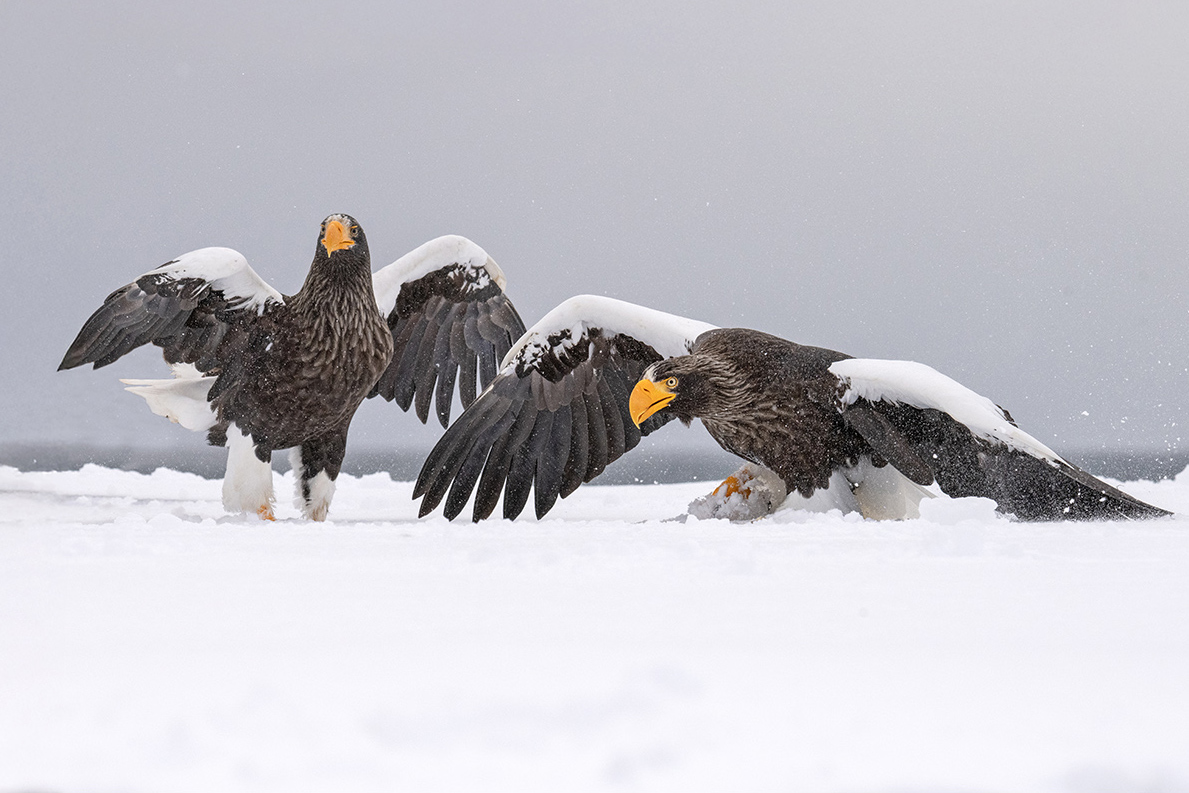
If any bird has the hungry, chilling, predatory gaze of a feathered dinosaur, then it surely must be the Steller’s sea eagle.
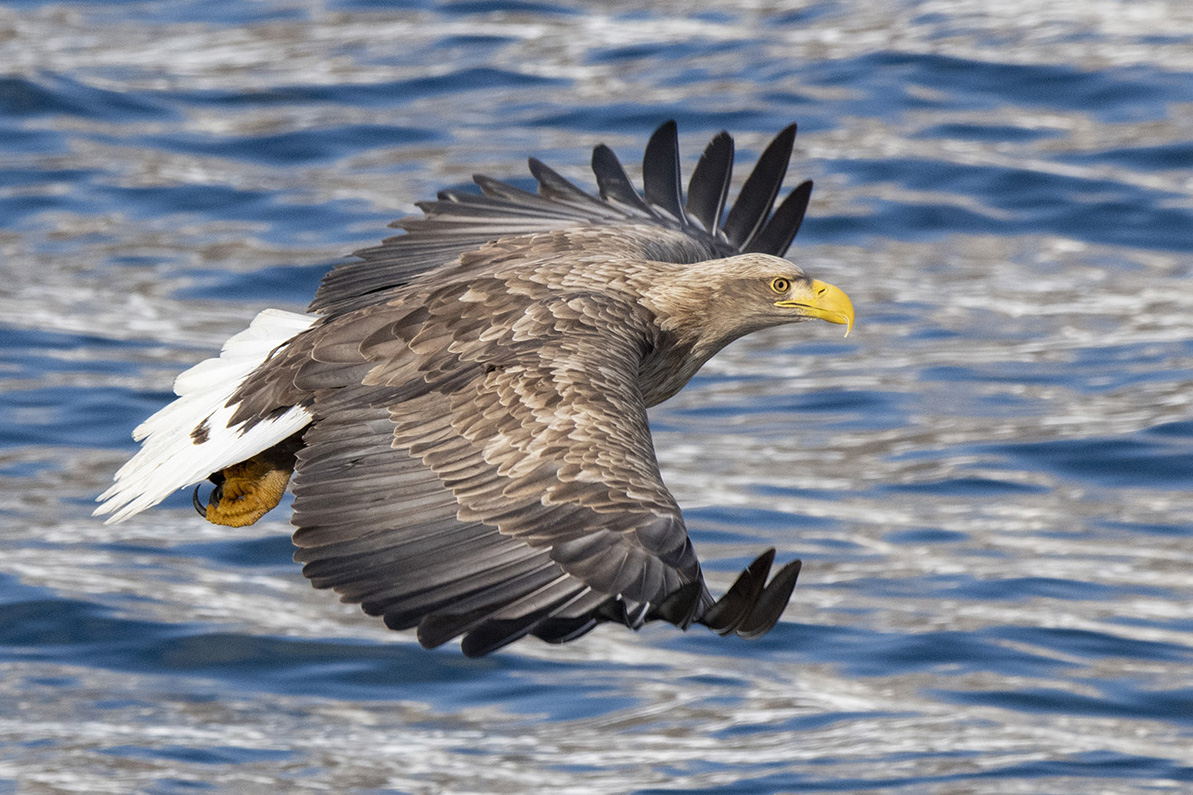
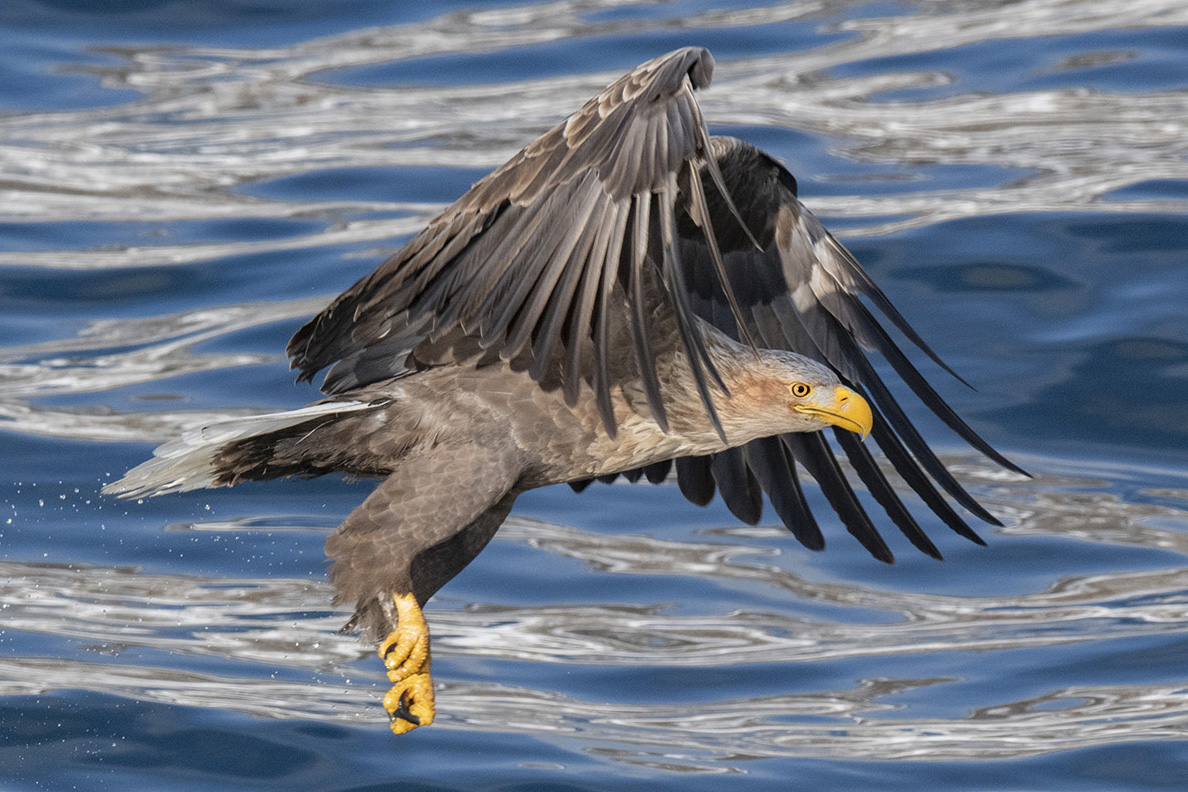
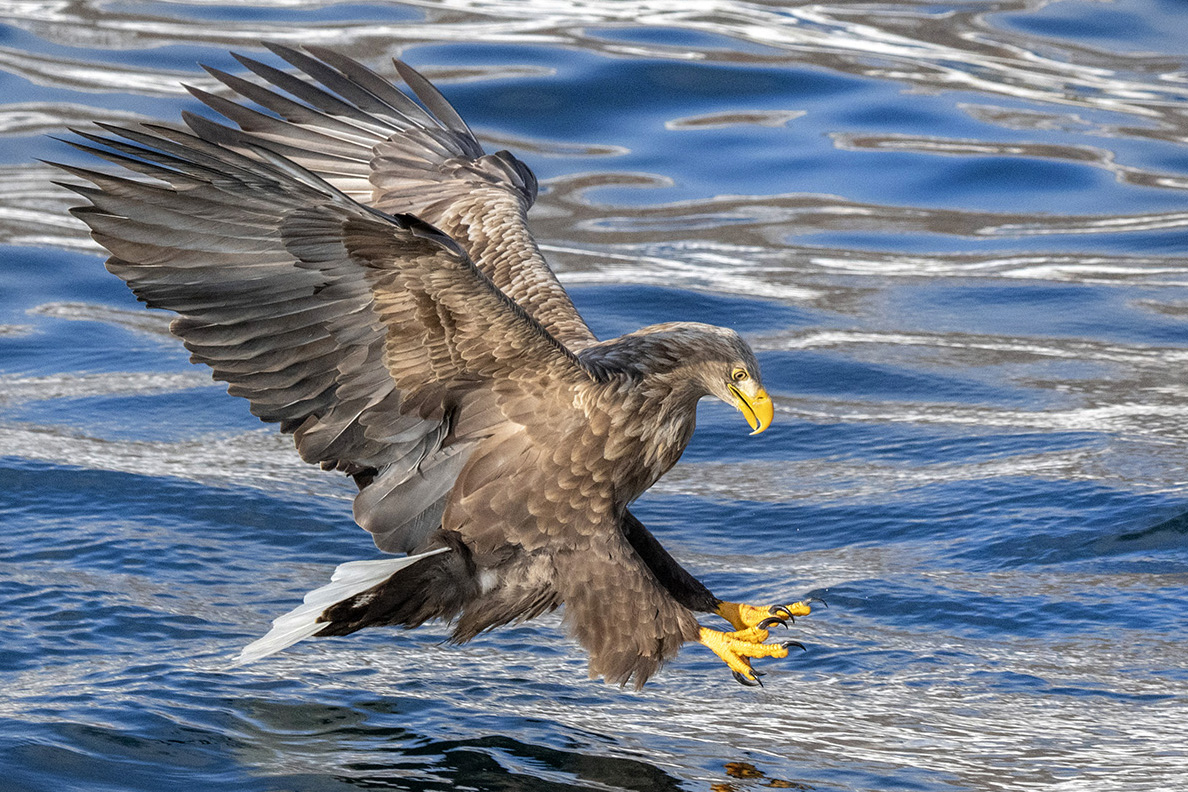
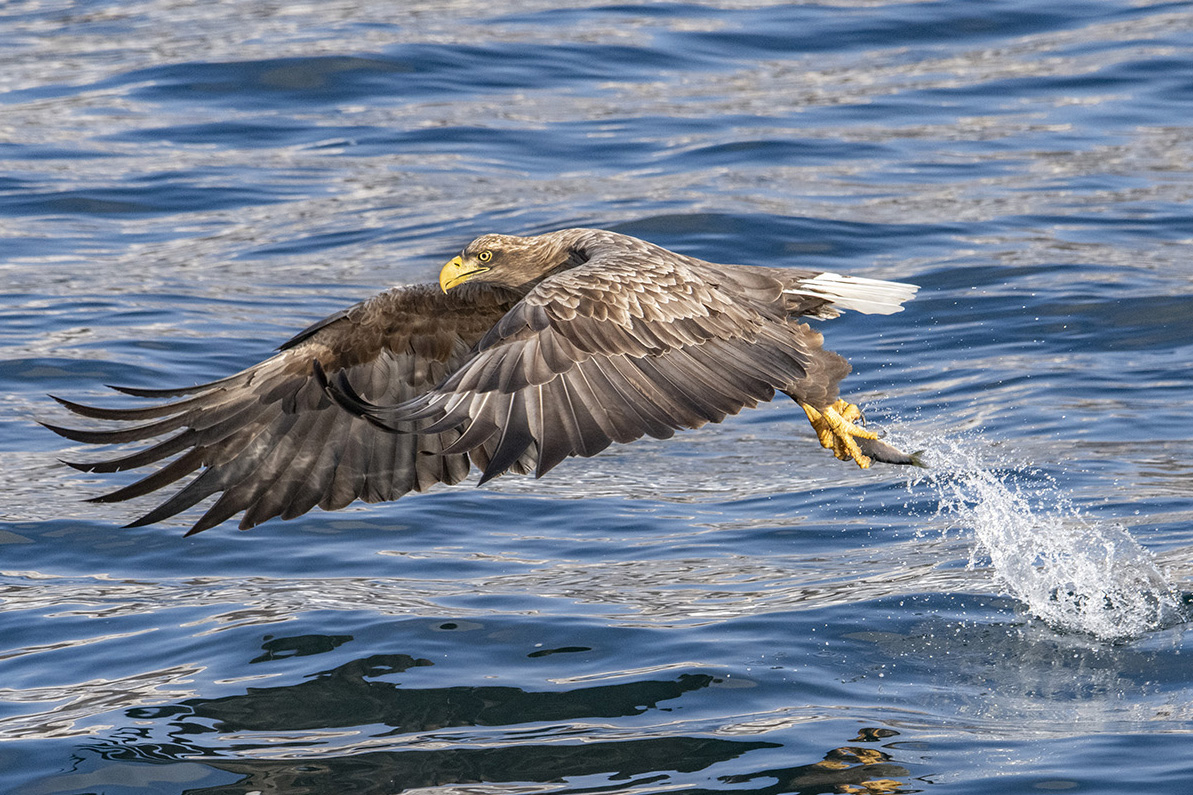
The whitetail’s large wing surface area allows it to drift close to the water and effortlessly pluck a fish from the surface.
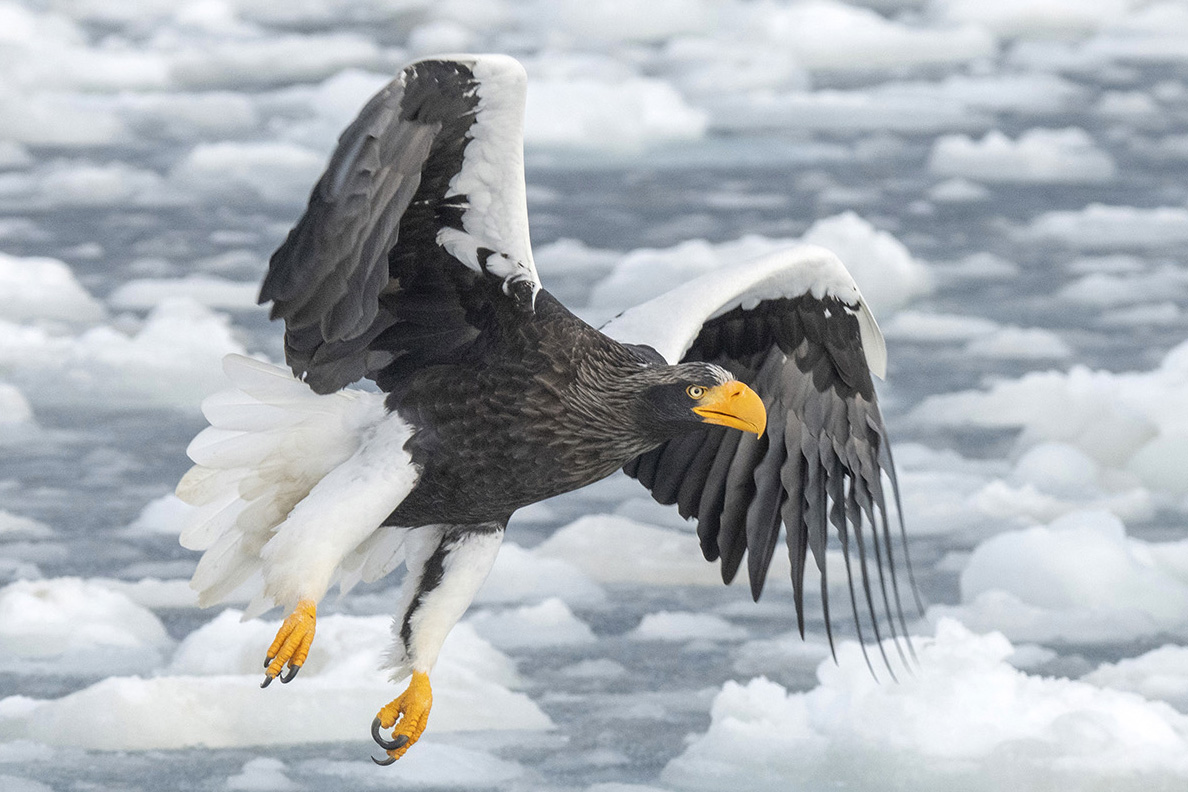
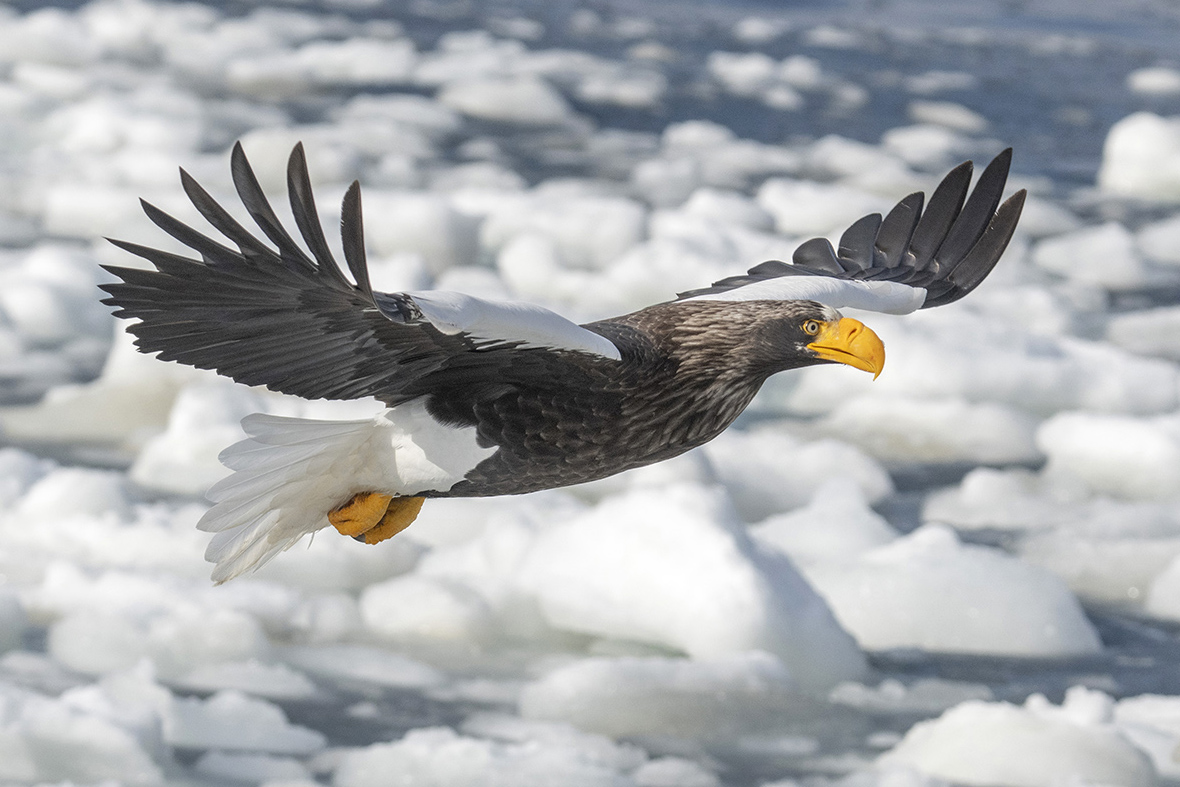
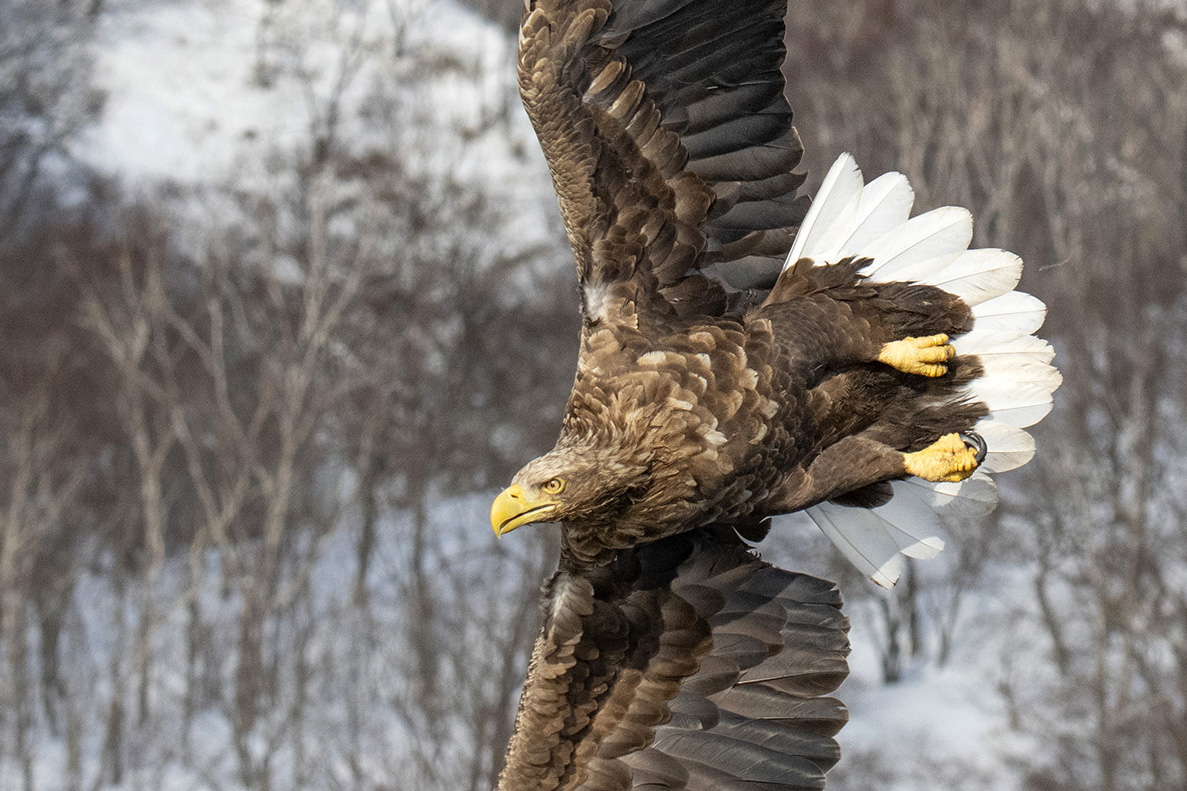
The two species of sea eagles, the Steller’s and the white-tailed, were easily the highlights of my two winter trips to Japan.
About the Author – Dr. Wayne Lynch

For more than 40 years, Dr. Wayne Lynch has been writing about and photographing the wildlands of the world from the stark beauty of the Arctic and Antarctic to the lush rainforests of the tropics. Today, he is one of Canada’s best-known and most widely published nature writers and wildlife photographers. His photo credits include hundreds of magazine covers, thousands of calendar shots, and tens of thousands of images published in over 80 countries. He is also the author/photographer of more than 45 books for children as well as over 20 highly acclaimed natural history books for adults including Windswept: A Passionate View of the Prairie Grasslands; Penguins of the World; Bears: Monarchs of the Northern Wilderness; A is for Arctic: Natural Wonders of a Polar World; Wild Birds Across the Prairies; Planet Arctic: Life at the Top of the World; The Great Northern Kingdom: Life in the Boreal Forest; Owls of the United States and Canada: A Complete Guide to their Biology and Behavior; Penguins: The World’s Coolest Birds; Galapagos: A Traveler’s Introduction; A Celebration of Prairie Birds; and Bears of the North: A Year Inside Their Worlds. In 2022, he released Wildlife of the Rockies for Kids, and Loons: Treasured Symbols of the North. His books have won multiple awards and have been described as “a magical combination of words and images.”
Dr. Lynch has observed and photographed wildlife in over 70 countries and is a Fellow of the internationally recognized Explorers Club, headquartered in New York City. A Fellow is someone who has actively participated in exploration or has substantially enlarged the scope of human knowledge through scientific achievements and published reports, books, and articles. In 1997, Dr. Lynch was elected as a Fellow to the Arctic Institute of North America in recognition of his contributions to the knowledge of polar and subpolar regions. And since 1996 his biography has been included in Canada’s Who’s Who.