



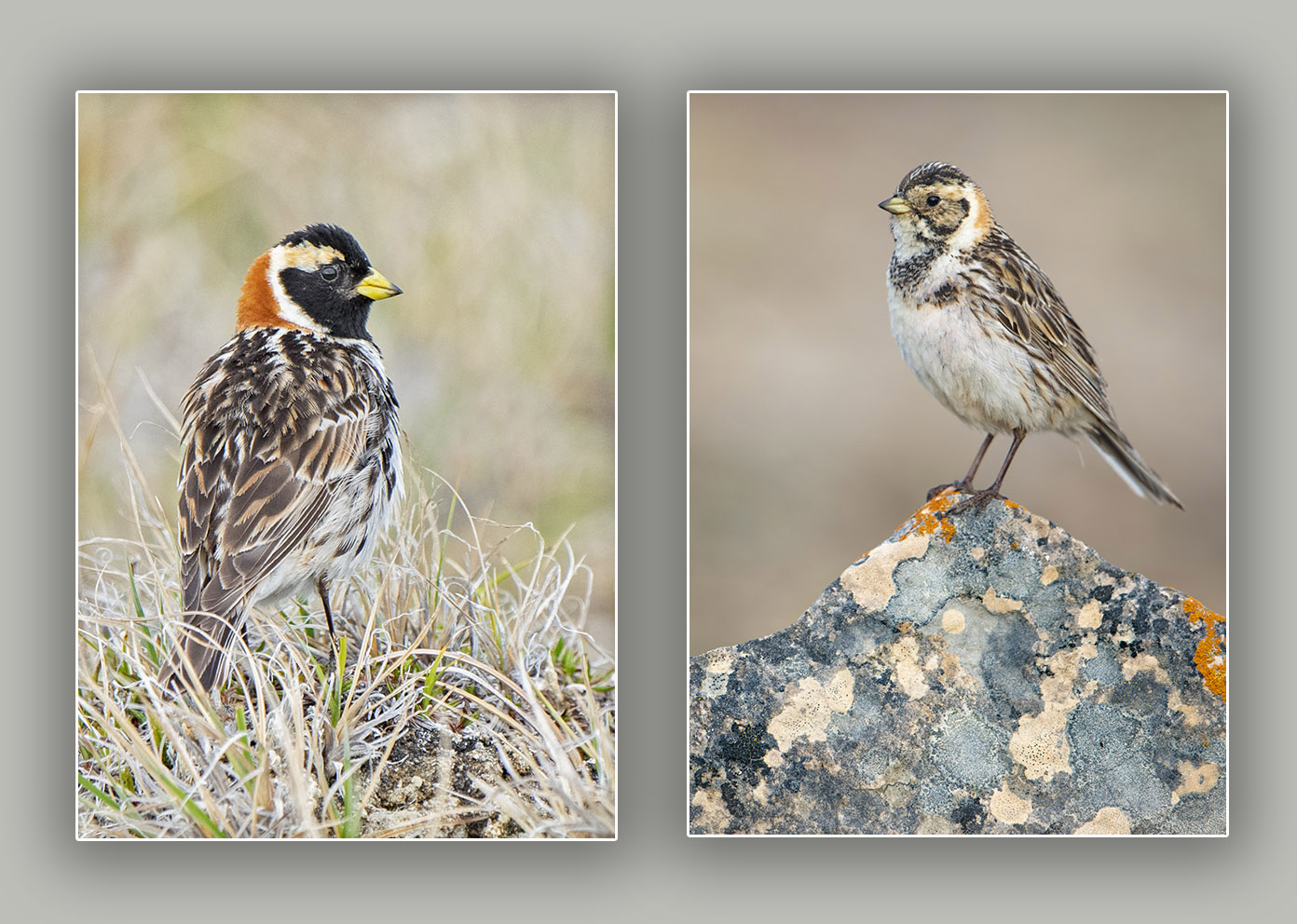
The Lapland longspur, a circumpolar songbird, is arguably the most abundant Arctic-nesting terrestrial species in the world. As is typical of most songbirds, the male (pictured on the left) is much more colourfully feathered than the female, who incubates the eggs and broods the young in a hidden nest where cryptic plumage is advantageous. The longspur gets its name from the elongated hind claw (or “spur”) – the purpose of which is unclear- it has on both of its feet.
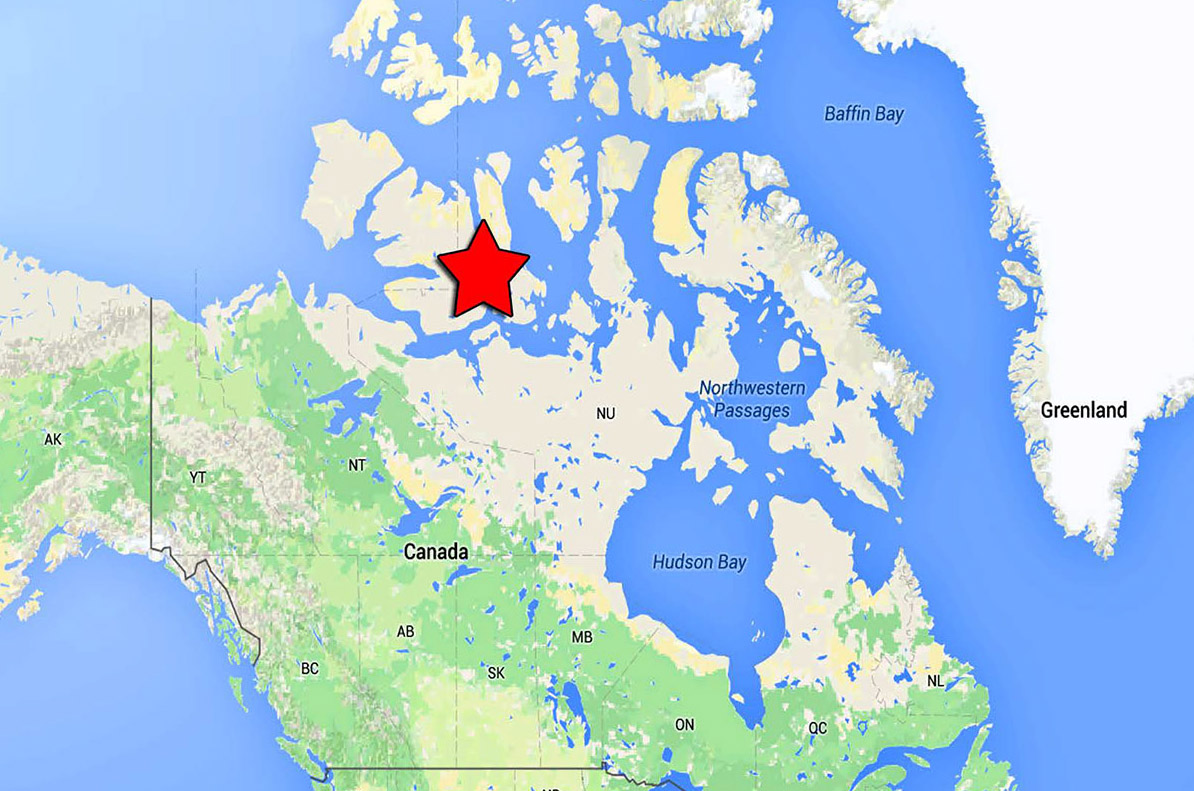
Victoria Island is in the territory of Nunavut
This month, I want to continue my celebration of Canada’s natural wonders with a photographic experience I had several summers ago. In 2022, I spent four glorious weeks on Victoria Island, Nunavut, at 69 degrees North, roughly 500 km (300 mi) north of the Arctic Circle. My main goal for the trip was to observe and photograph the three arctic-nesting species of loons: the red-throated loon, Pacific loon, and yellow-billed loon. Not surprisingly, many other bird species captured my attention. Their beauty and diversity made them hard to ignore, and I witnessed a remarkable spectrum of avian behaviour.
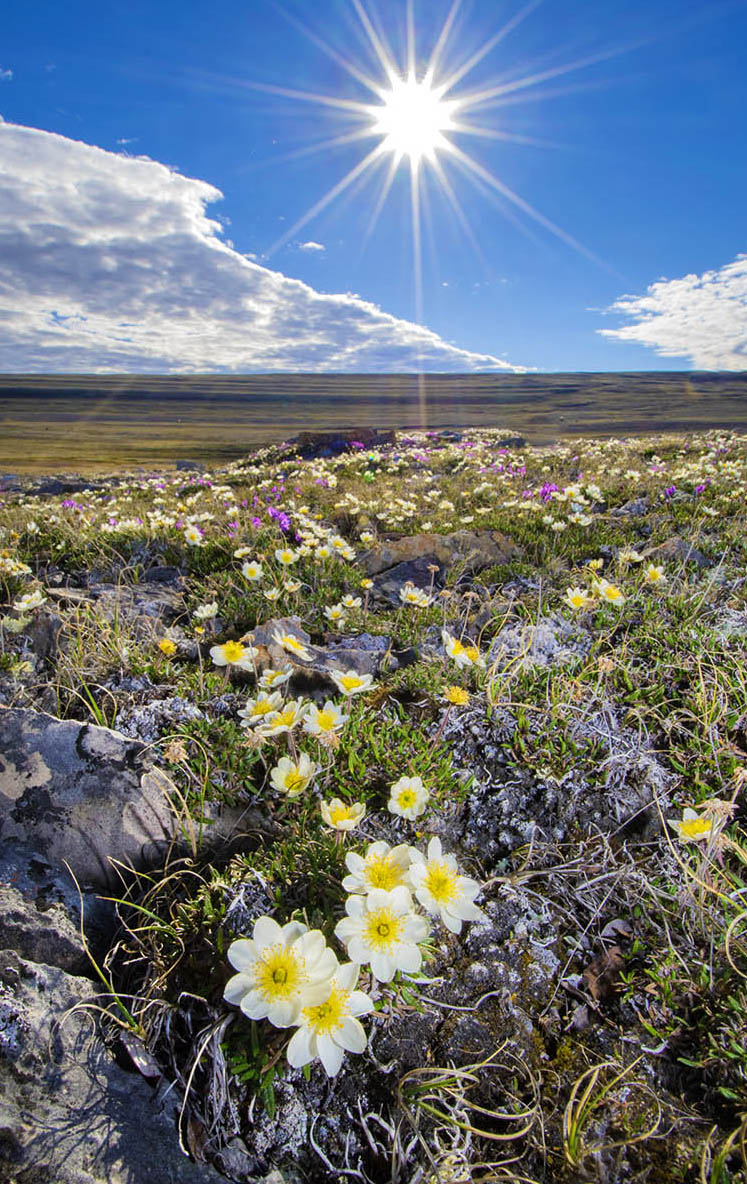
The Arctic tundra can at times be a surprising carpet of multi-coloured flowers.
That summer, Victoria Island was colder than usual, with temperatures rarely creeping above 9C (49F), and sometimes dipping below freezing in the nighttime hours. Add to that a seemingly constant wind of 20 to 30 kph, often gusting to 50 to 60 kph, and you have an exceptionally chilly summer. Back home in Calgary, it often simmered in the 30s, and the skies were frequently clouded with smoke from wildfires in neighbouring British Columbia. The good news for me on Victoria Island was that there were no mosquitoes. I didn’t get bitten by one until the 18th of July, two weeks after I arrived.
I learned a few important lessons on that trip. #1 I didn’t think it was medically possible for every joint in one’s body to ache at the same time. #2 Don’t wade to islands separated from the mainland by cold, waist-deep, genital-shrivelling water where the lake bottom is layered in deep, muddy ooze that will terminally swallow your favourite Crocs and leave you barefoot to walk back to your vehicle across tundra menacingly littered with blades and jagged plates of splintered shale. #3 Trekking many kilometres over hummocky, ankle-twisting tundra is not the same as walking on a level hiking trail back home. #4 When three elusive and rare, yellow-billed loons decide to interact near your photo blind, make sure you have a memory card in your camera (definitely a rookie mistake).
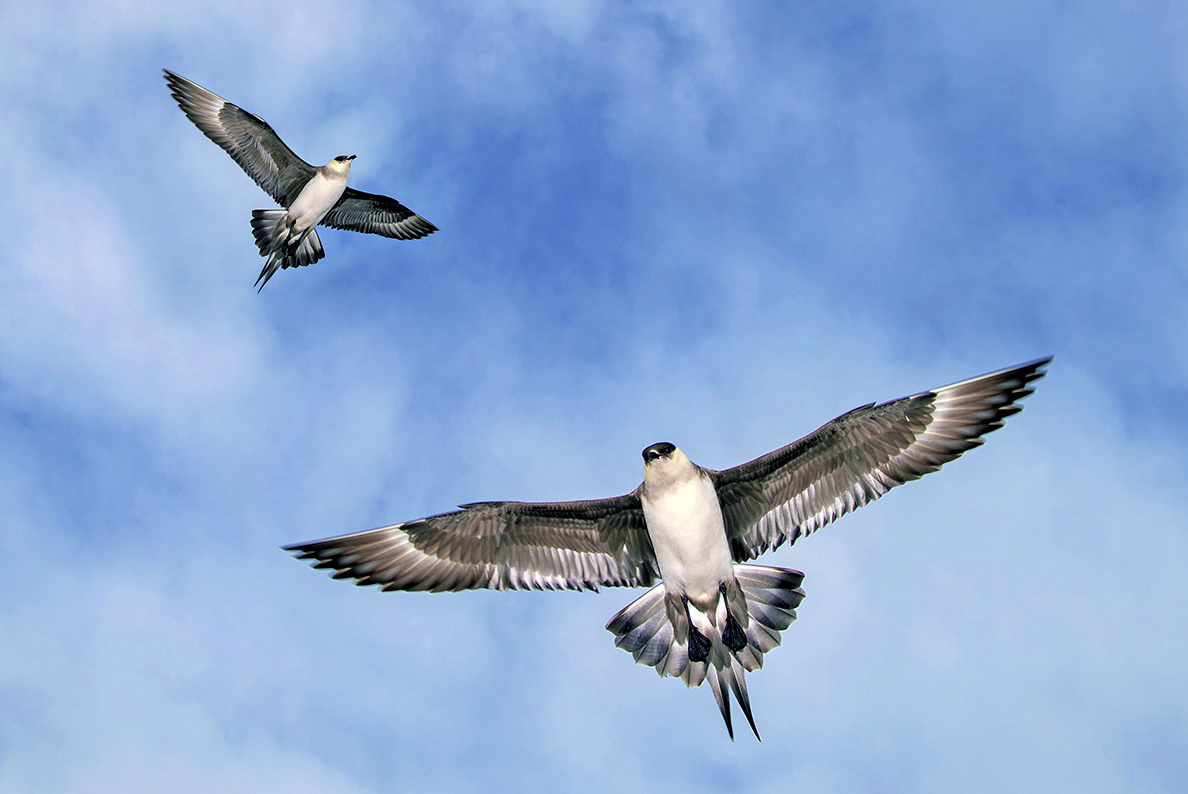
The common name of the parasitic jaeger (pronounced YAY-gur) is derived from the German word for hunter, a reflection of its predatory nature. Jaegers are the thugs of the Arctic that feed on eggs, small birds, and lemmings.
Luckily, I learned many great things that offset the challenges. #1 The sunlight at 2 am in the Arctic is as sweet as liquid gold. #2 Watching wildlife in wild solitude is indescribably energizing. #3 The haunting cries of sandhill cranes, loons, and geese flying overhead are my favourite kind of music. #4 Four weeks without the discouraging, mind-numbing world of global politics is unexpectedly liberating.
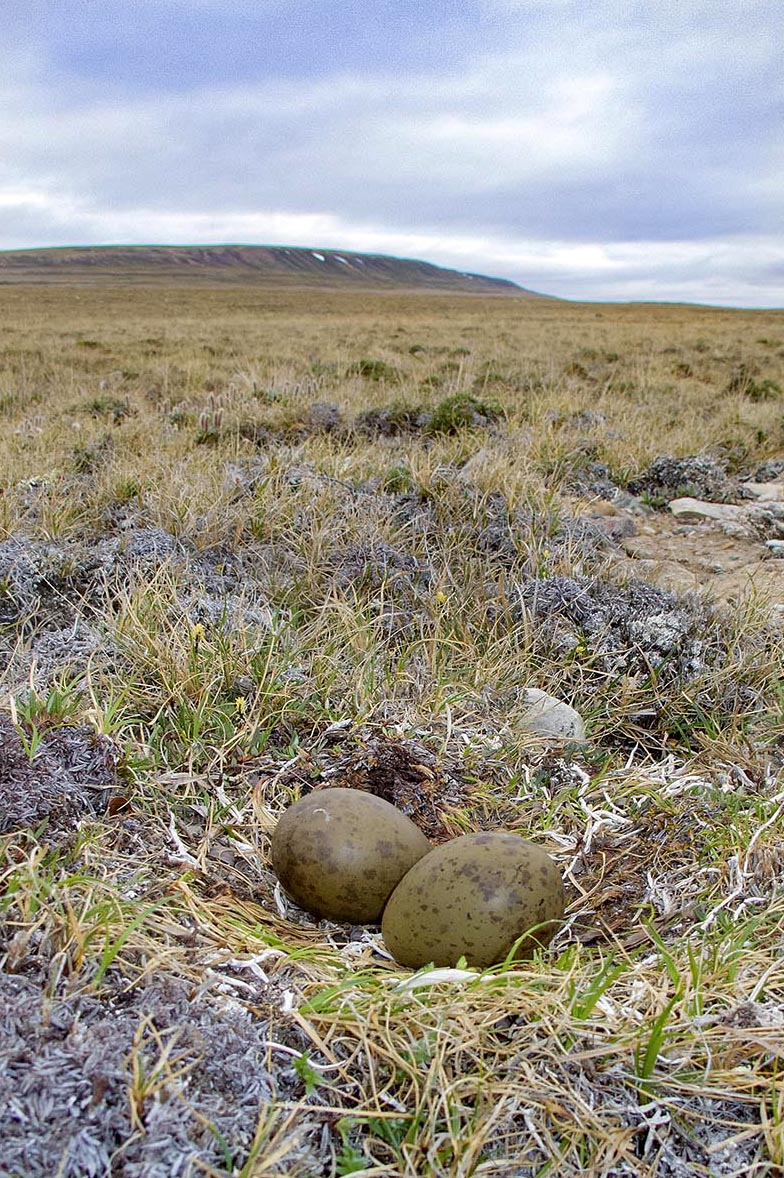
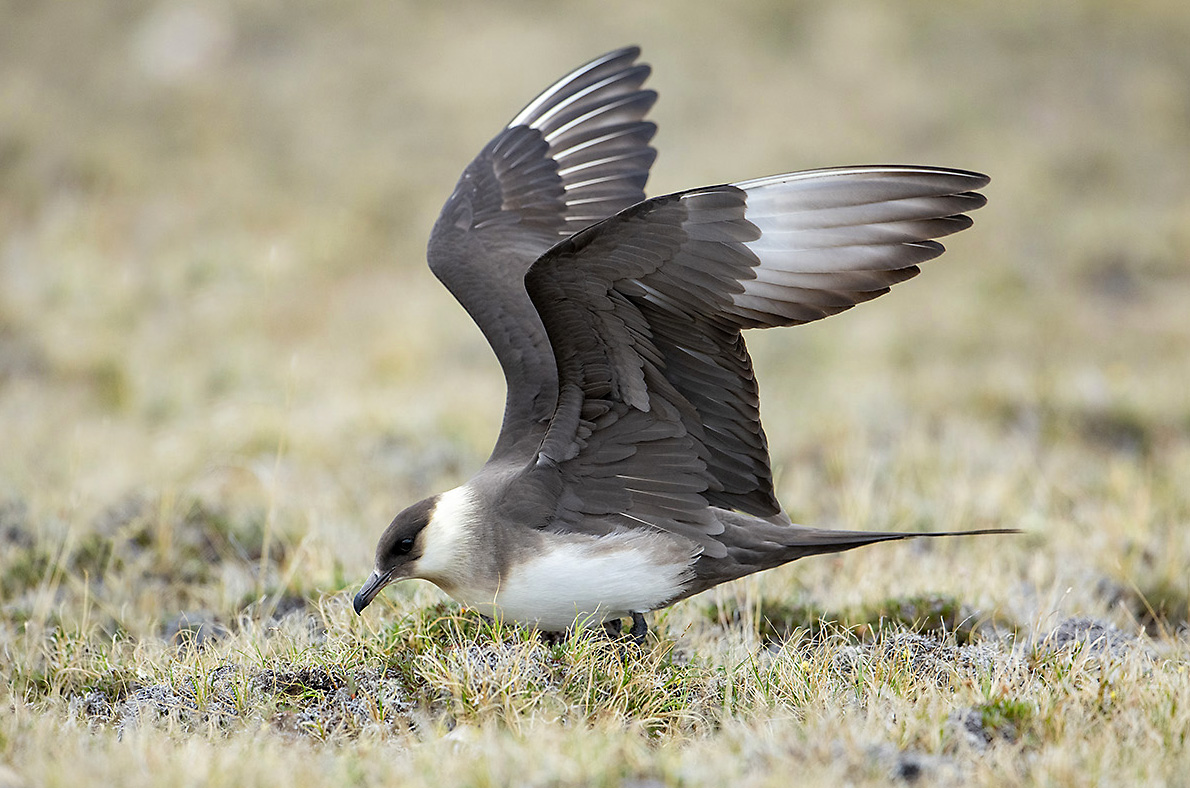
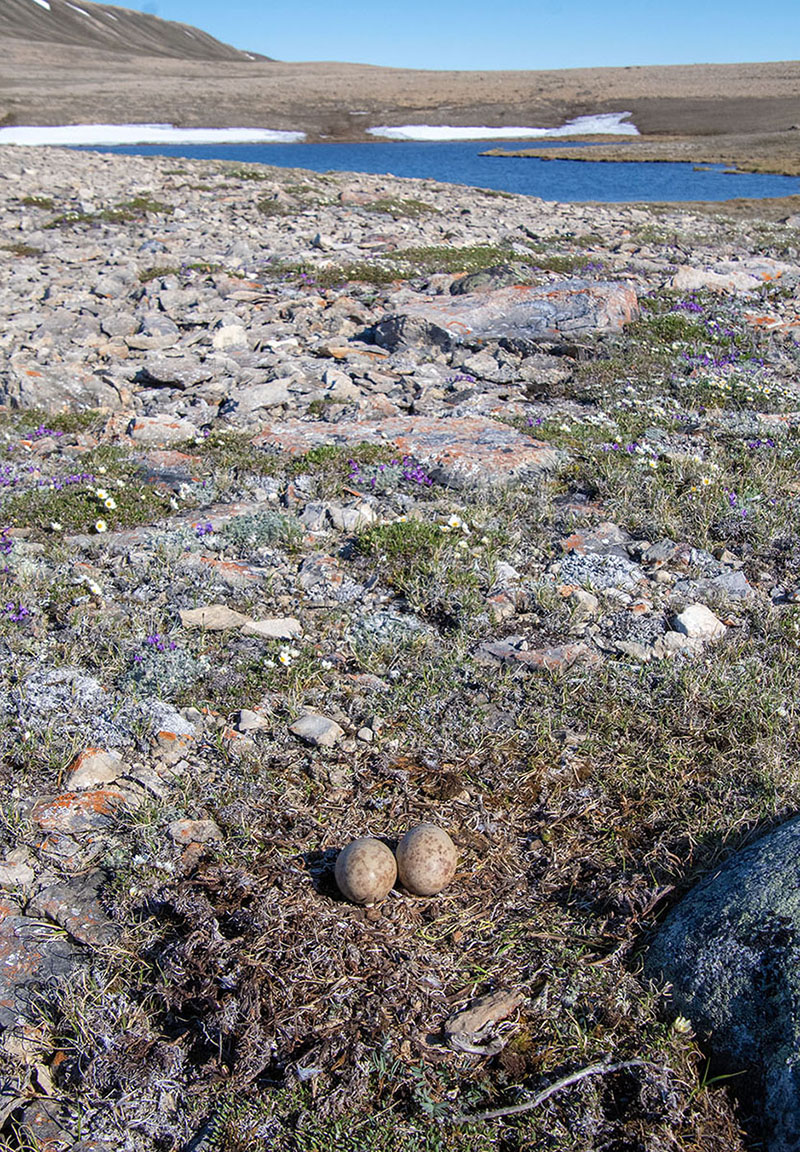
The parasitic jaeger lays one or two eggs, which are incubated by both parents, although the female sits on the eggs more than the male.
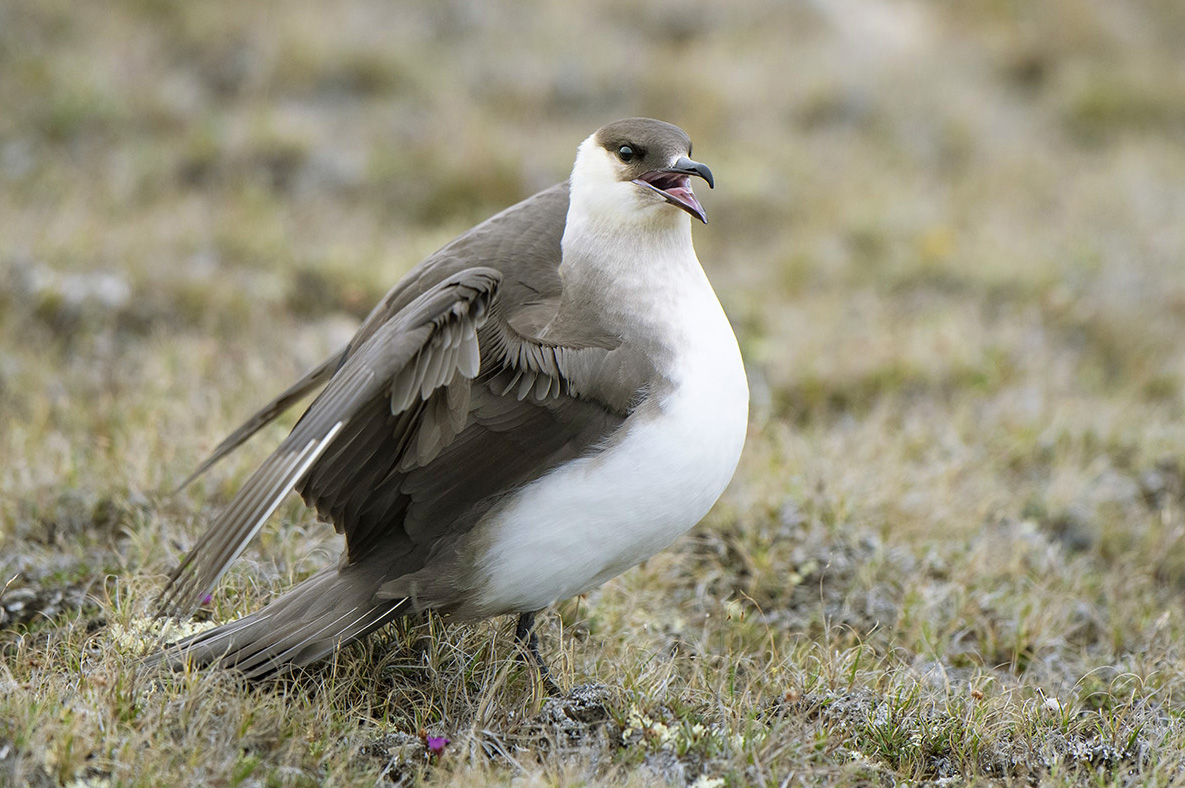
The jaegers are close relatives of the gulls that have modified the basic gull pattern so that, in many ways, they resemble birds of prey. They have strong hooked bills, sharp curved claws, and hard, tough scales on their legs. Female jaegers are also larger than males, another characteristic they share with birds of prey.
One day, when I was aimlessly wandering over the tundra, I flushed a sandhill crane off its nest. Nesting cranes are usually very hard to spot, and the few I have stumbled upon were all by accident. The crane, which stands over a metre tall and has a body as big as a goose, typically builds its nest on the ground where it is vulnerable to detection by hungry predators such as foxes, bears, wolves, and humans.
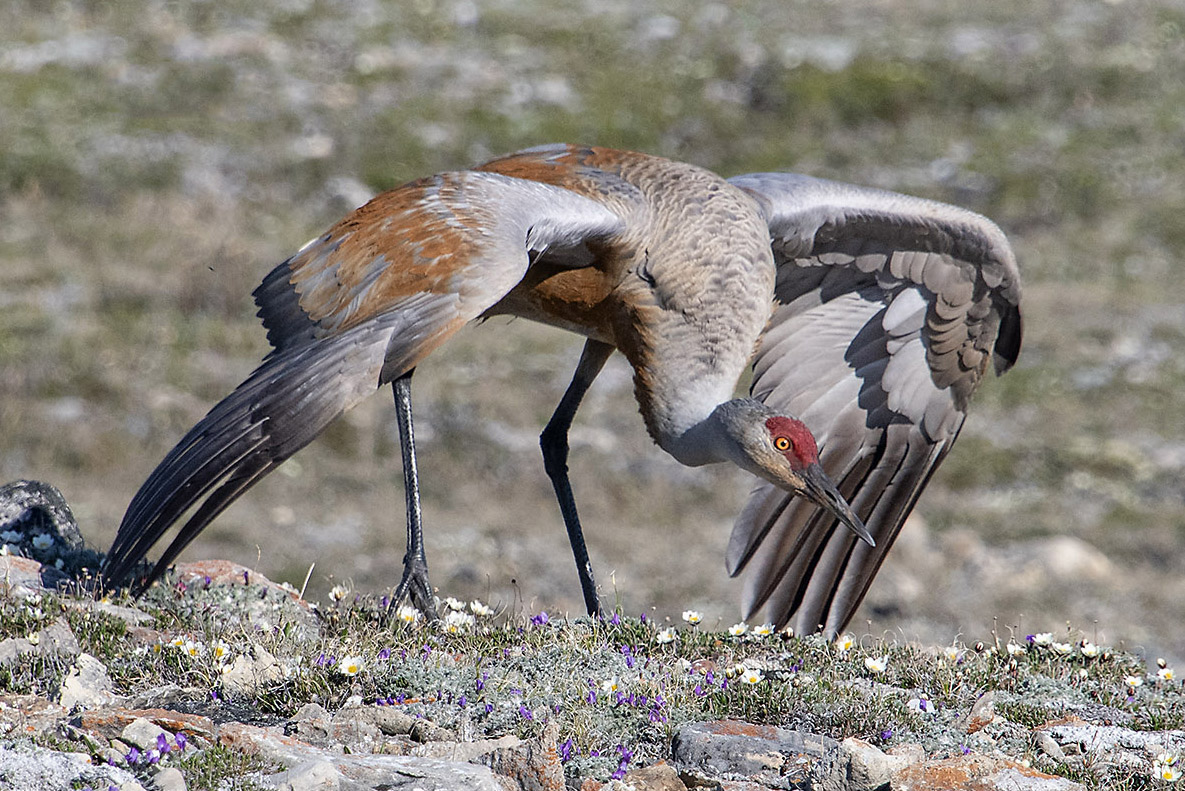
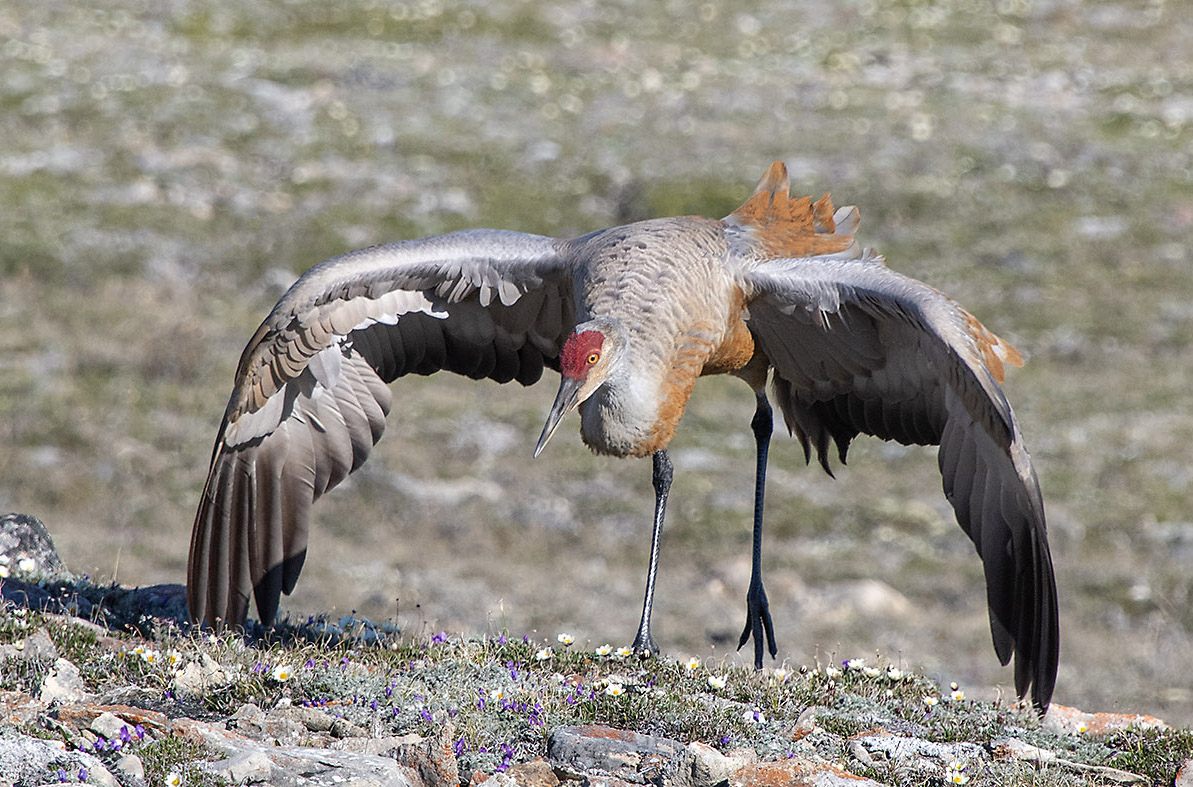
When a predator is spotted, a nesting crane hides by flattening itself against the ground. It stays frozen like this until the predator gets within two or three metres, when at the last moment it will suddenly jump up and flap wildly, hoping to lure the predator away from its nest.
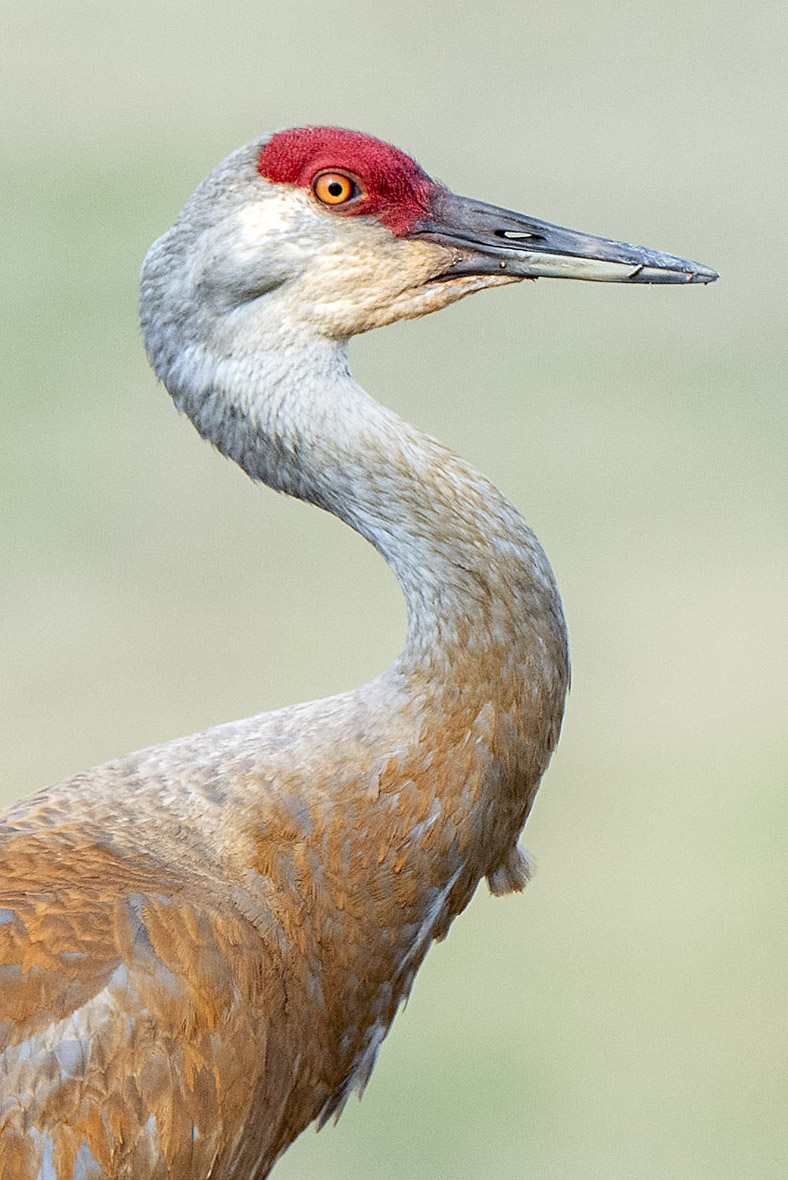
One of the reasons a nesting crane is so hard to see is that its rusty-tinted feathers blend so well with the colour of the ground.
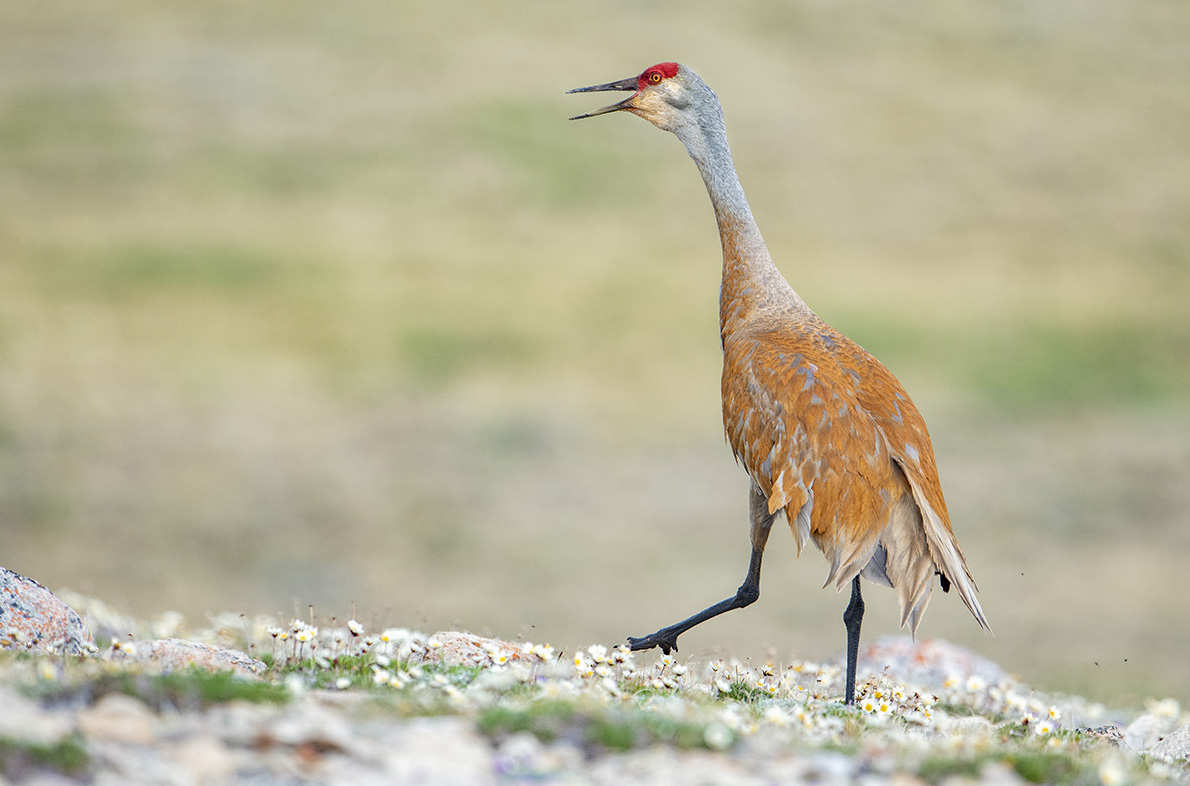
The crane’s masterful camouflage does not happen by chance. The sandhill crane is one of the few birds in the world that purposefully paints the feathers on its back and sides with wads of iron-oxide-rich mud. This behaviour stains the birds’ grey feathers a dark reddish-brown colour. In effect, the crane dabs natural cosmetic colouration on itself to make it less conspicuous when it is sitting on its nests out in the open.
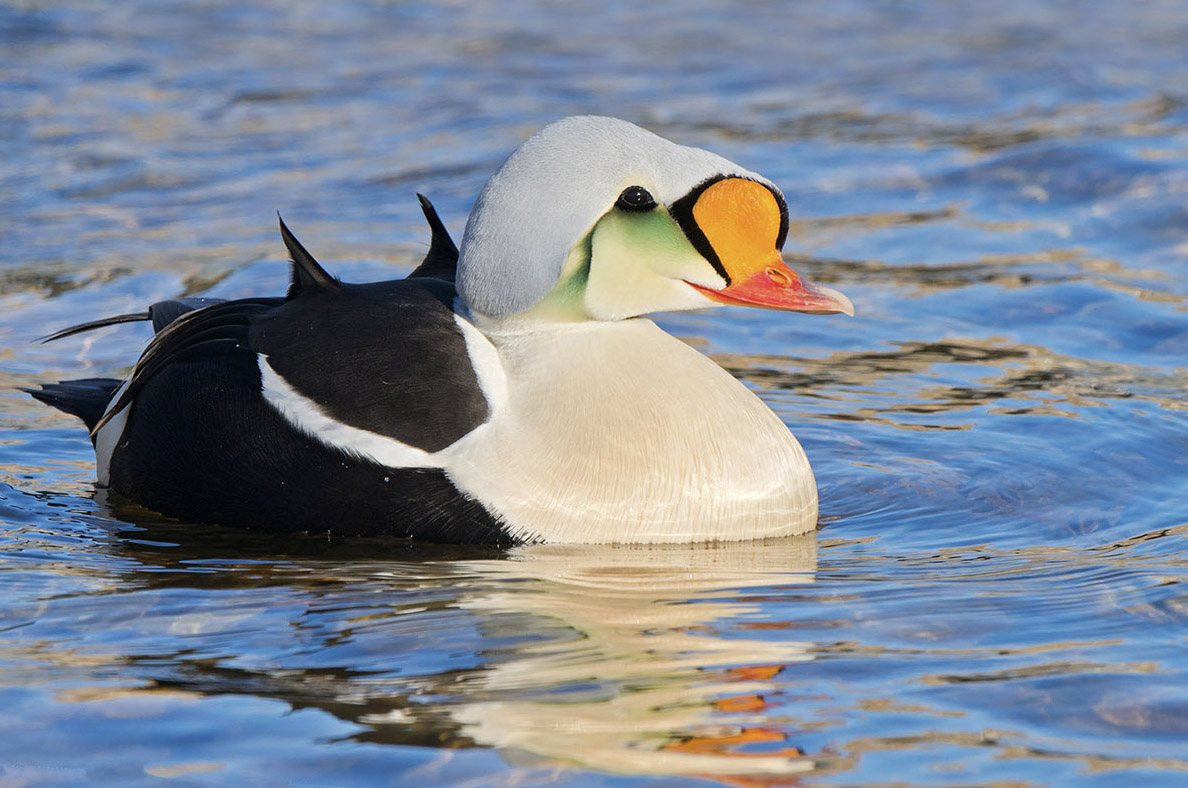
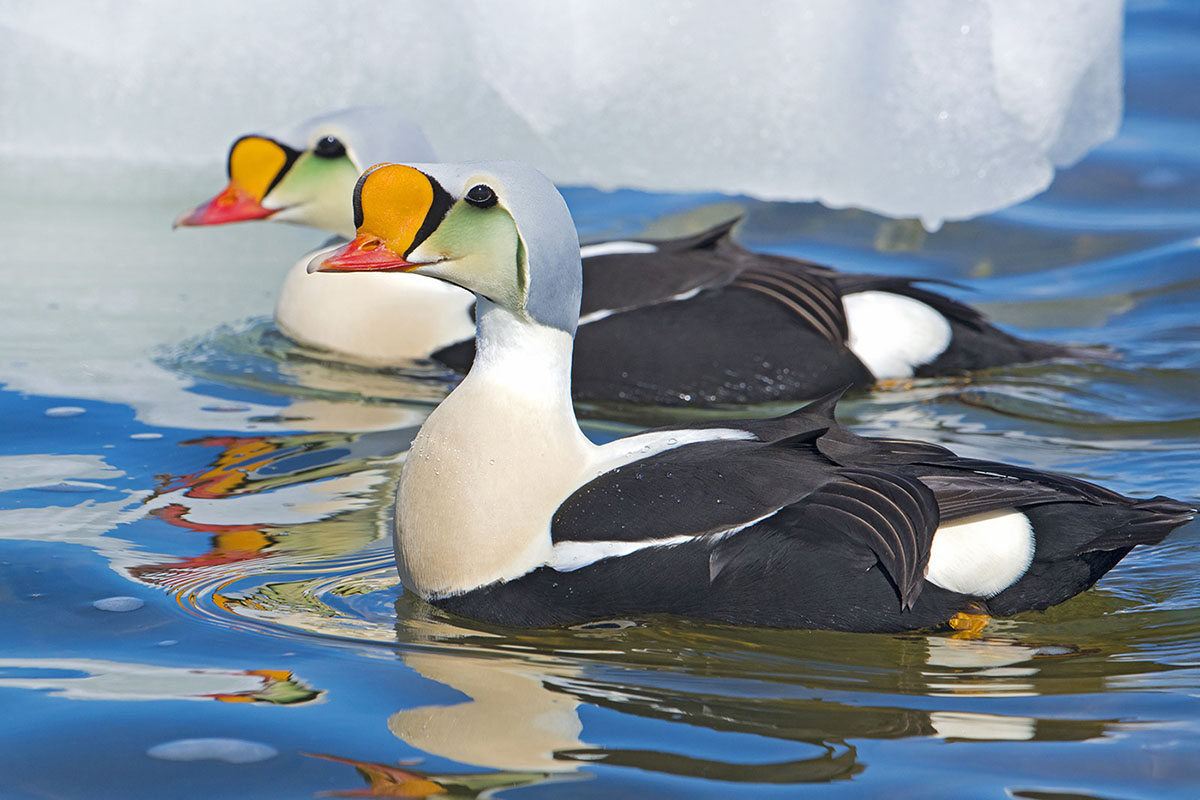
The king eider, whose scientific name is Somateria spectabilis, is, for my money, the Arctic’s most stunningly beautiful bird.
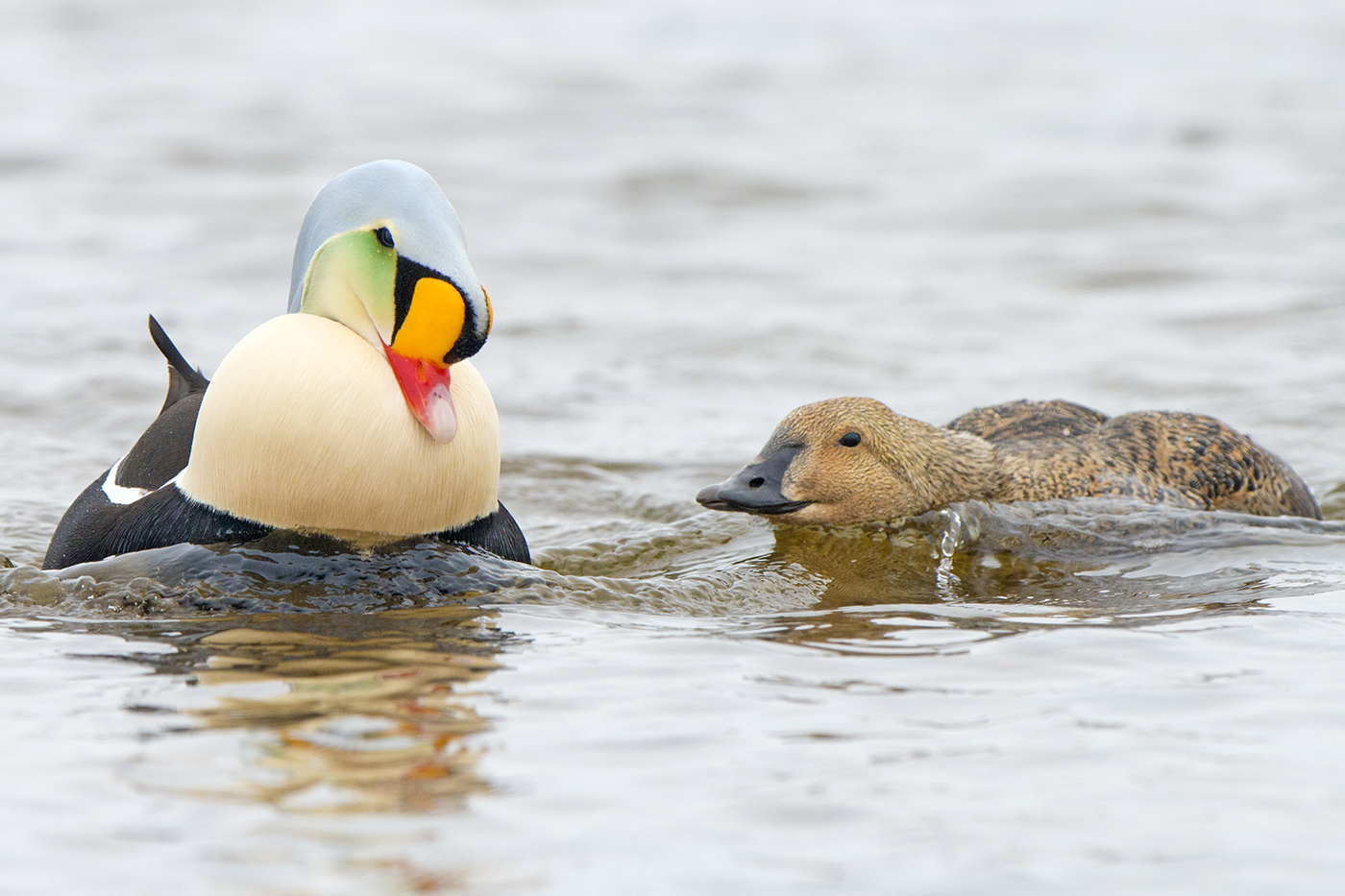
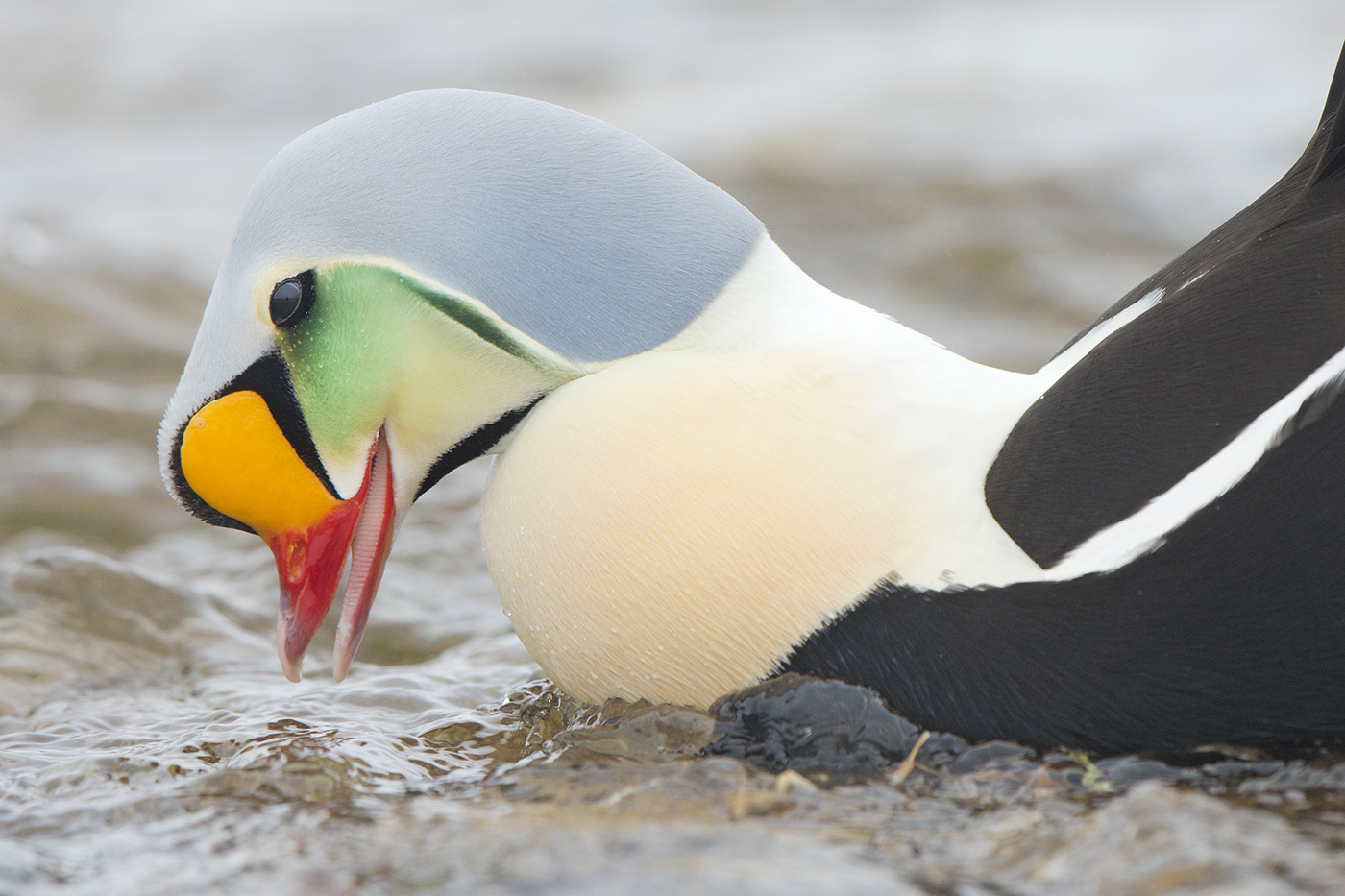
During the courtship displays that I watched on Victoria Island, drakes would coo softly, then periodically arch their neck downward, puff up their chest and warble musically.
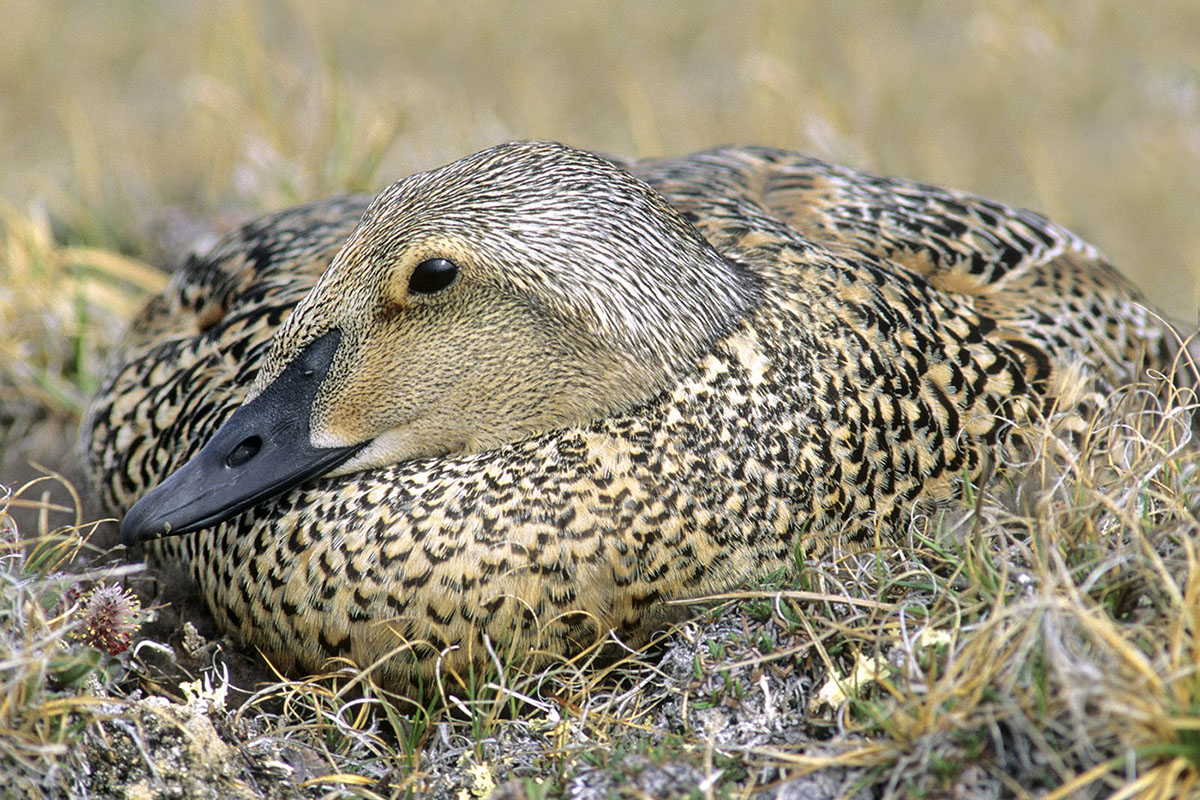
The cryptic brown females nest alone on the tundra and deposit their 3-6 olive-green eggs in a simple scrape on the ground lined with bits of vegetation and down that they pluck from their breasts. They are extremely well camouflaged on the nest and almost impossible to see. Researchers have discovered that some may not even flush when they are touched. The nesting range of the king eider extends to the top of Canada’s Ellesmere Island at a latitude of 82 degrees North, making it one of the world’s most northern nesting birds.
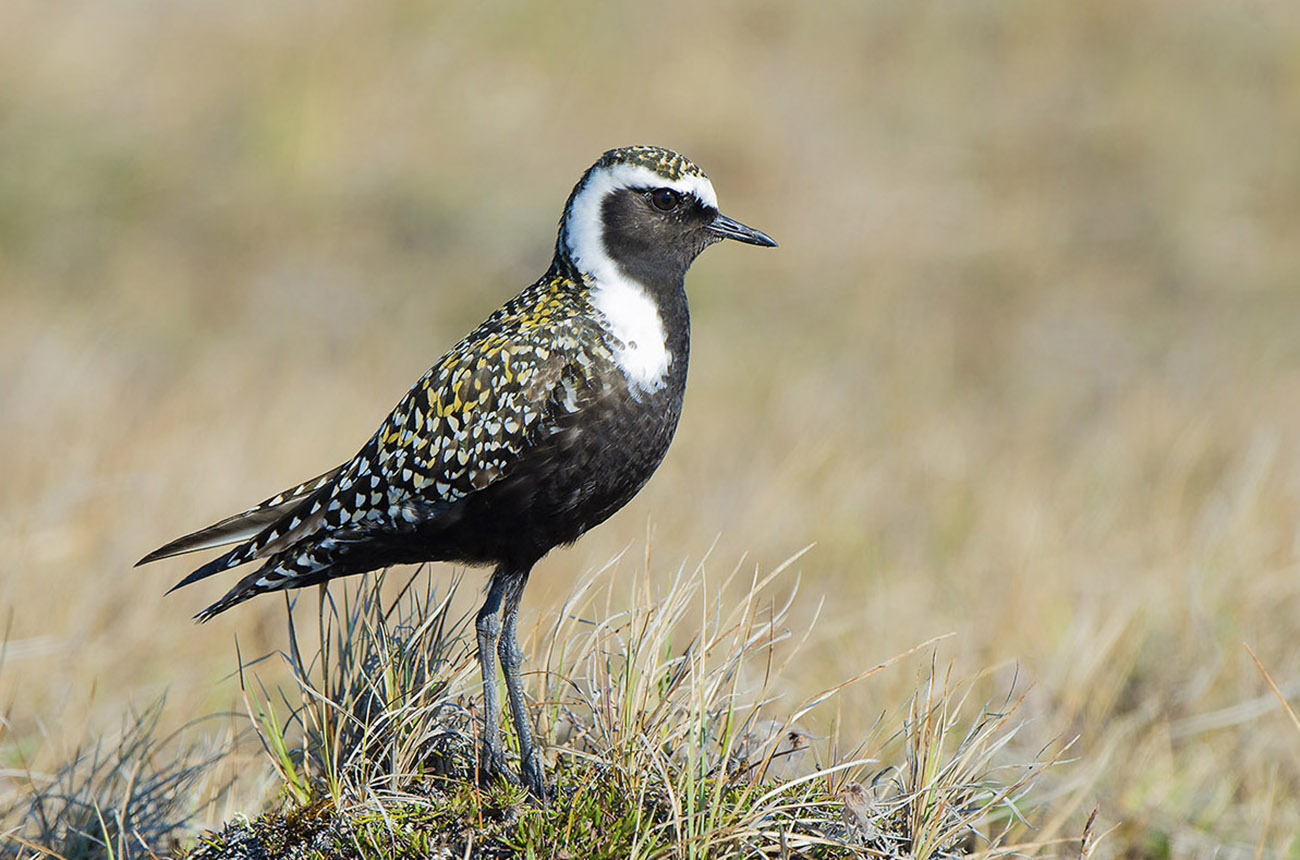
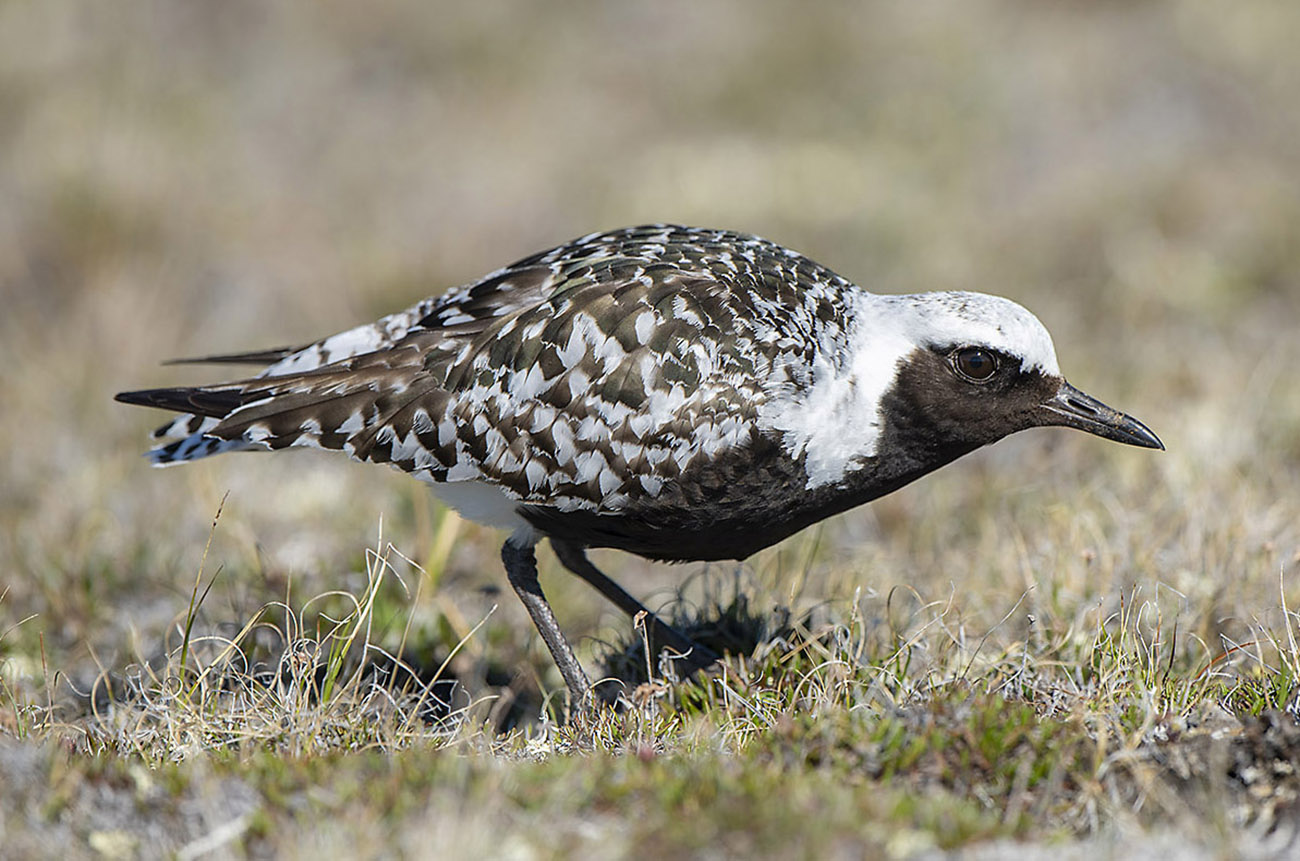
Nearly a third of all the birds breeding in the Arctic, including this handsome American golden plover, belong to the so-called shorebird group, which includes, among others, a mix of plovers, sandpipers, godwits and phalaropes.
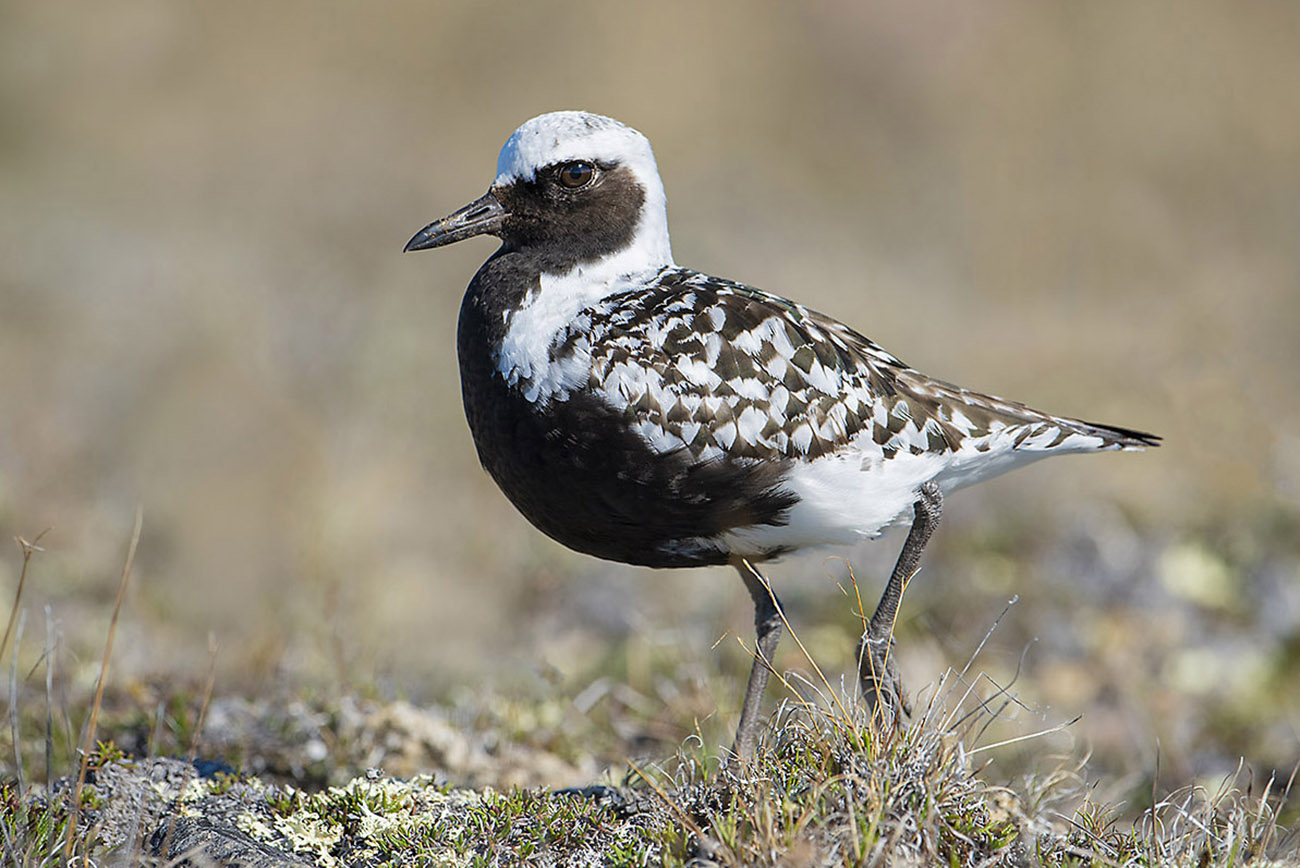
The snazzy, black-bellied plover, like all Arctic shorebirds, spends less than three months on its northern breeding ground, so its is not actually a bird of the Arctic at all; rather, it is a bird of the tropic and temperate zones that honeymoons for a short time each year in the Arctic.
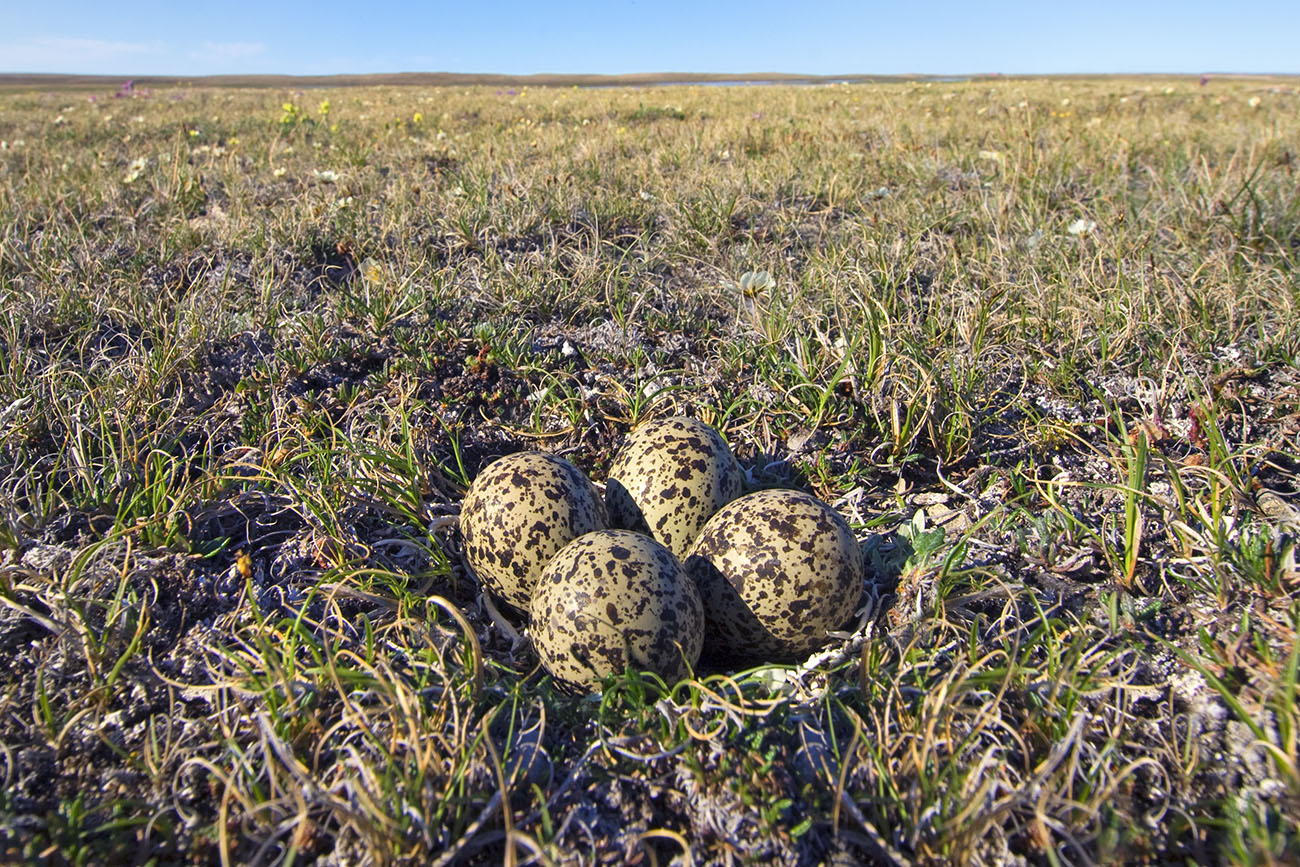
All shorebirds nest on the ground, and each normally lays a clutch of four camouflaged, pear-shaped eggs, which are incubated by both parents.
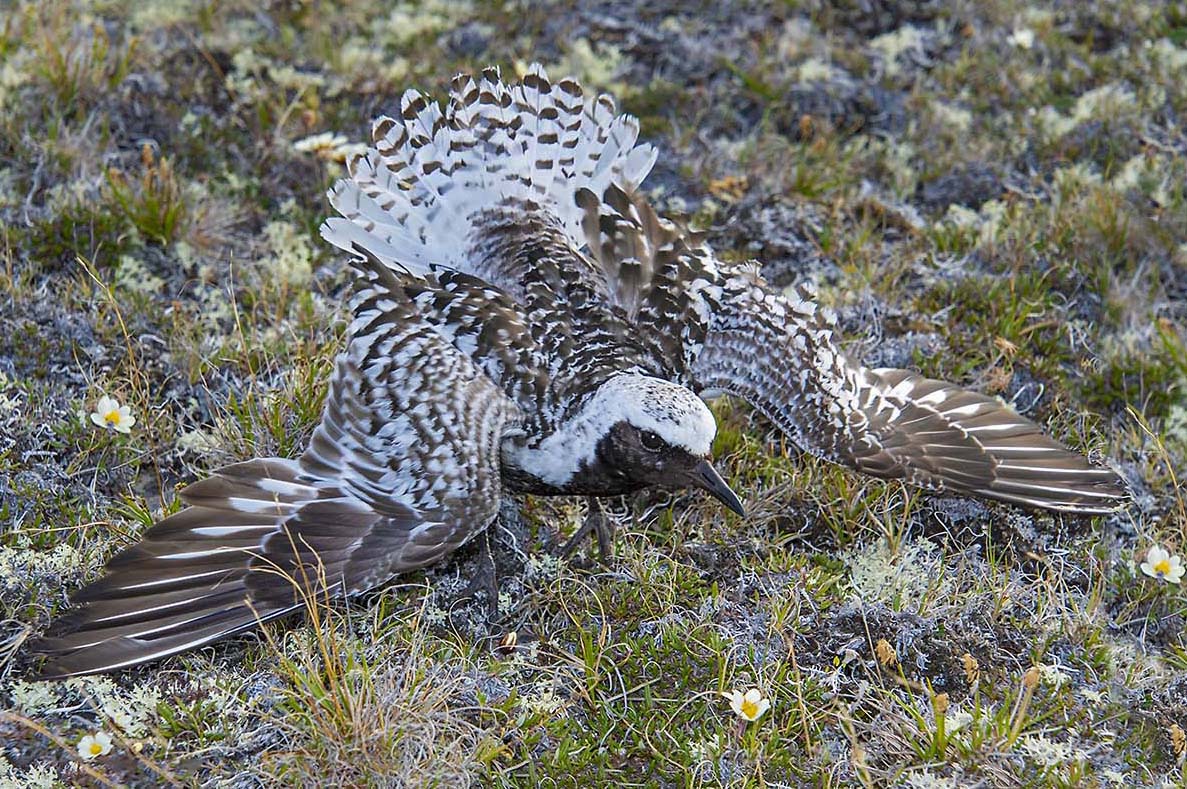
If a hungry Arctic fox, wolf or grizzly bear should wander near a shorebird nest, the incubating adult tries to distract the predator and lure it away from its vulnerable eggs or newly hatched chicks. It may even pretend to have a broken wing and flap about helplessly on the ground.
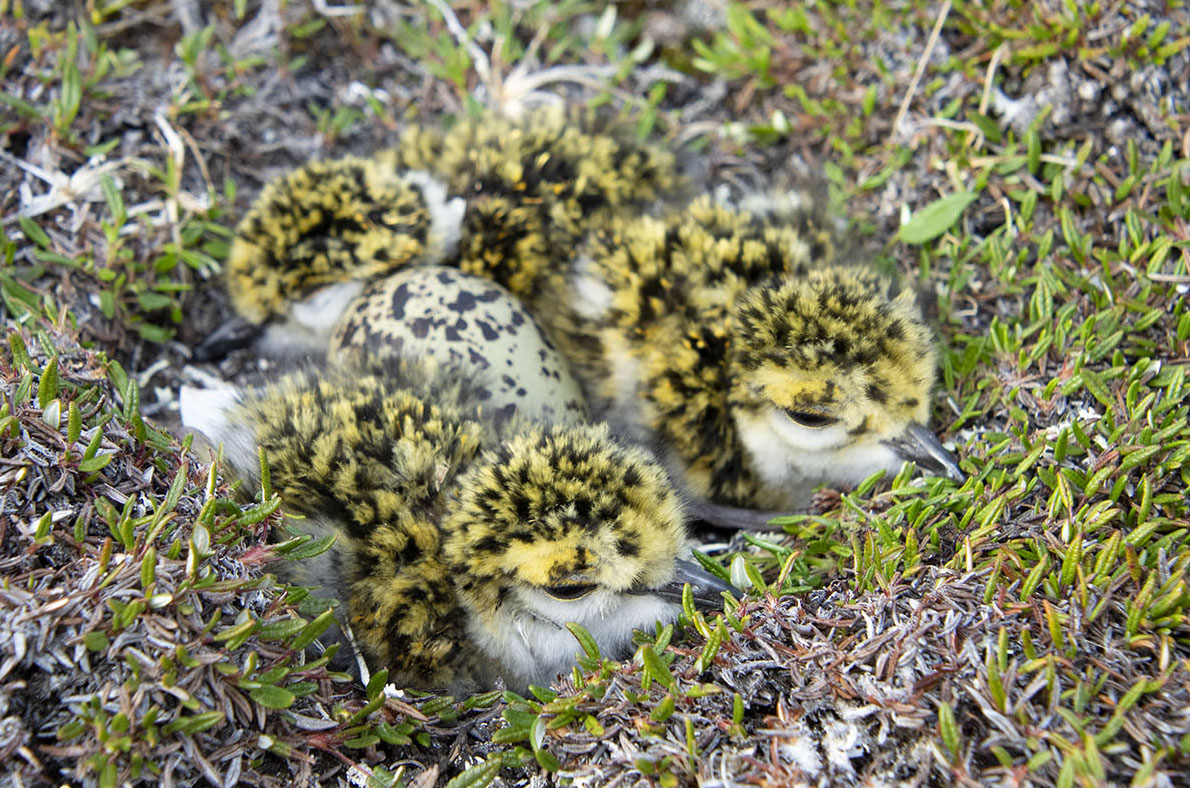
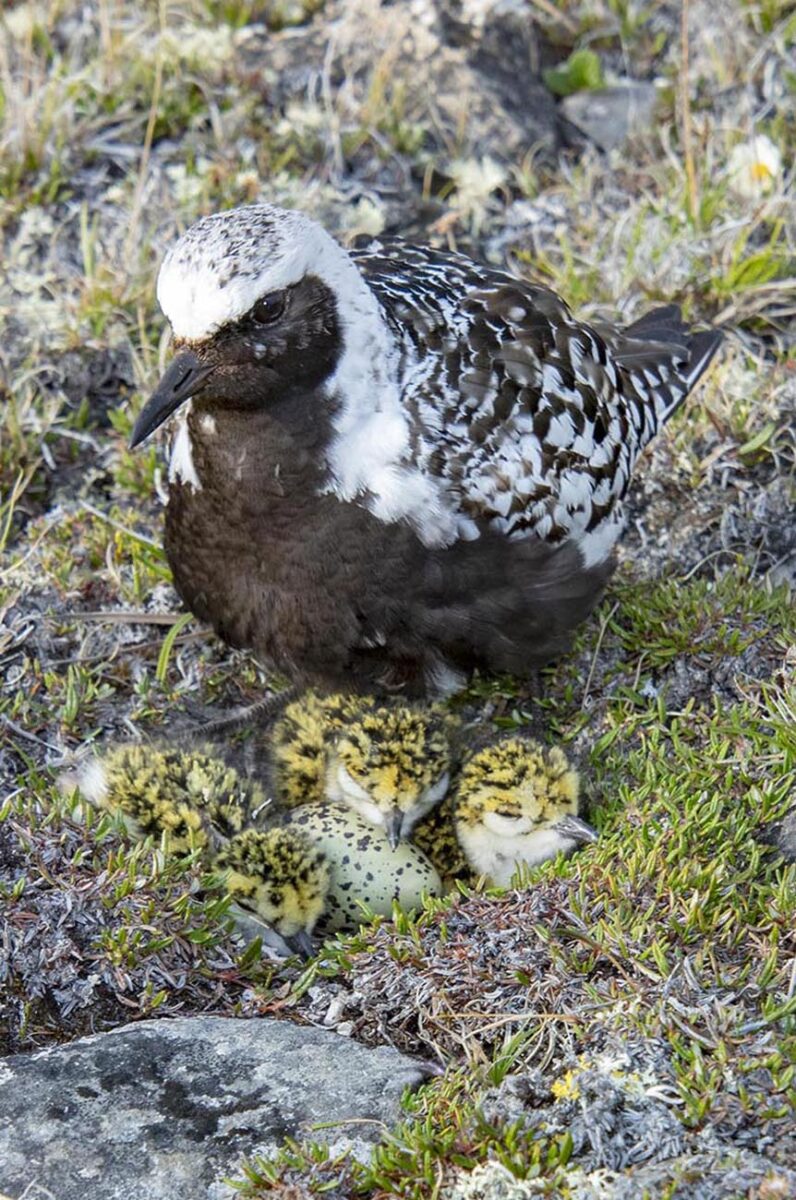
All shorebird eggs hatch within 24 hours of each other. The newly hatched chicks are covered with thick, fluffy down, but they can still become chilled and need to be brooded and warmed up by a parent.
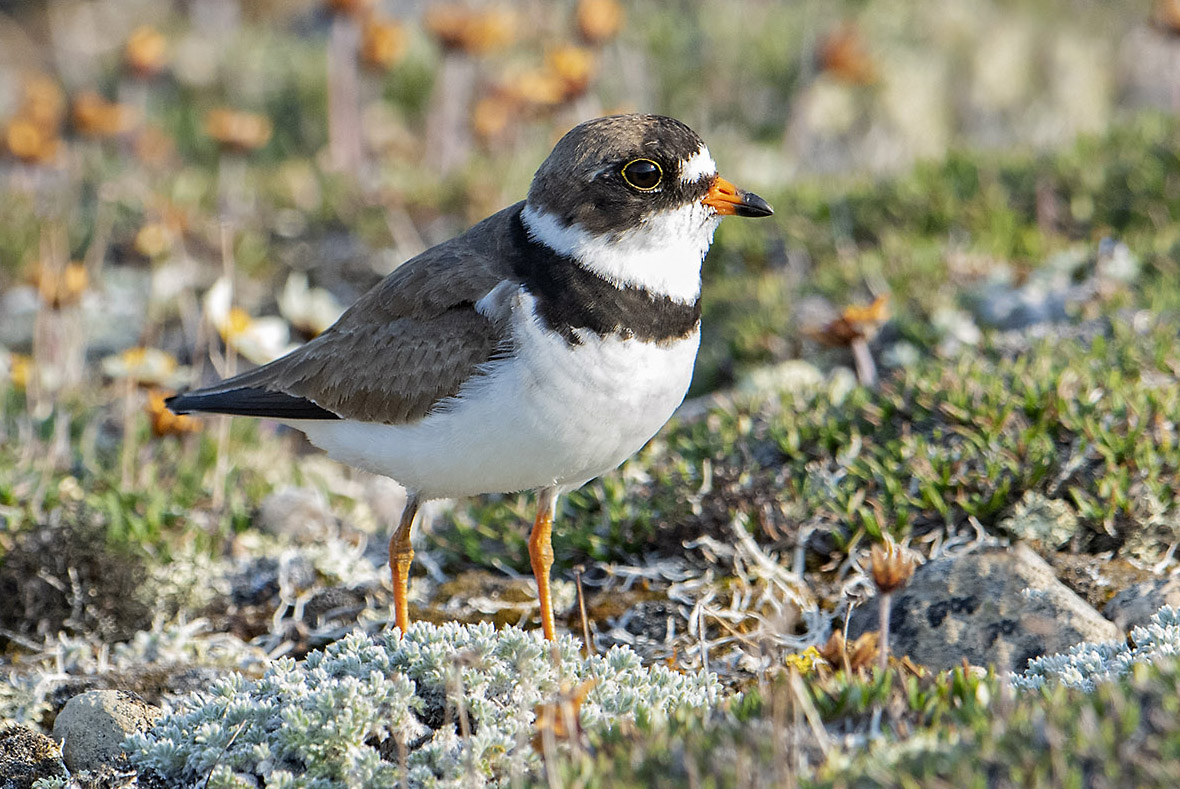
The semi-palmated plover’s common name refers to its partially webbed feet.
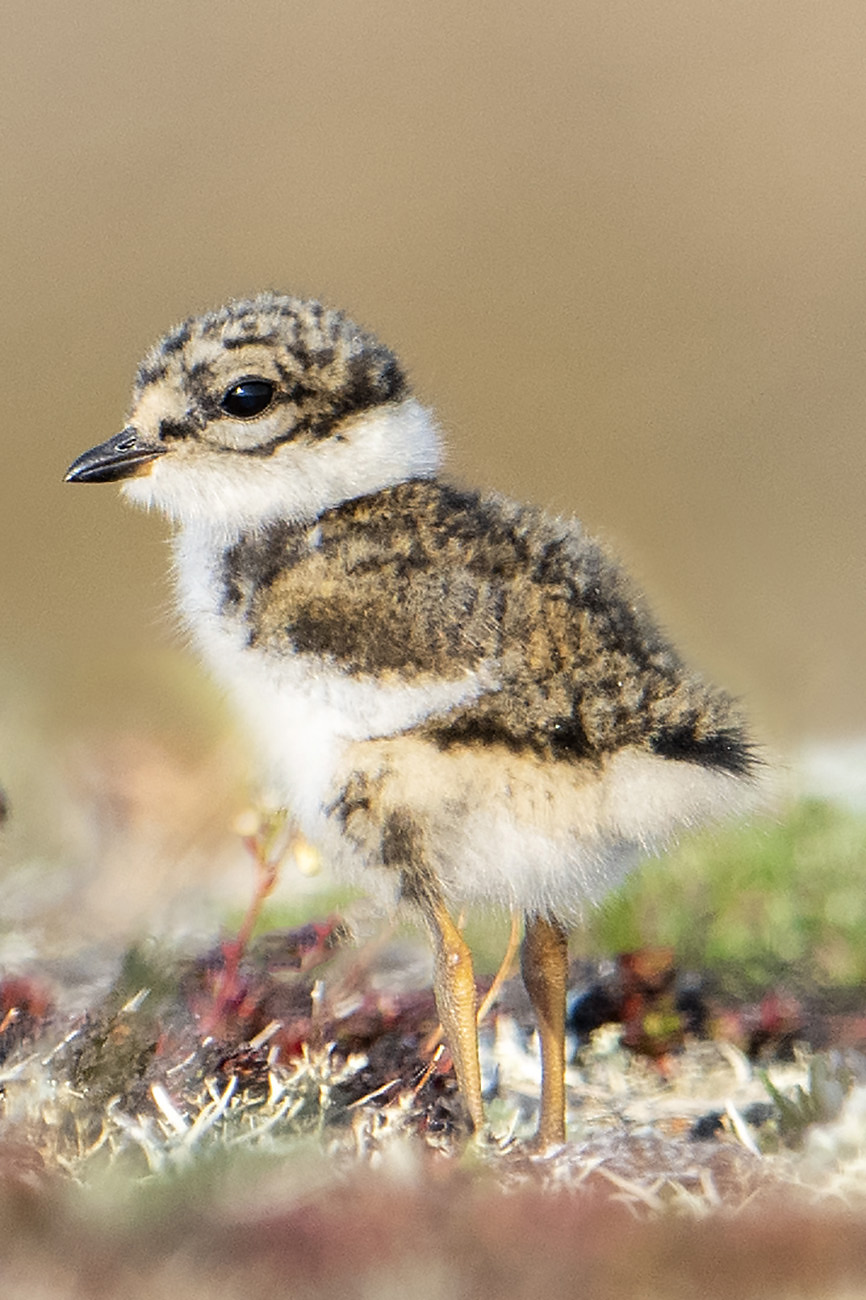
Within a day of hatching, this semi-palmated plover chick left the nest and followed its parents. Even when just a day or two old, it could run about, hide, and feed itself on insects and spiders under the watchful eye of its attentive parents.
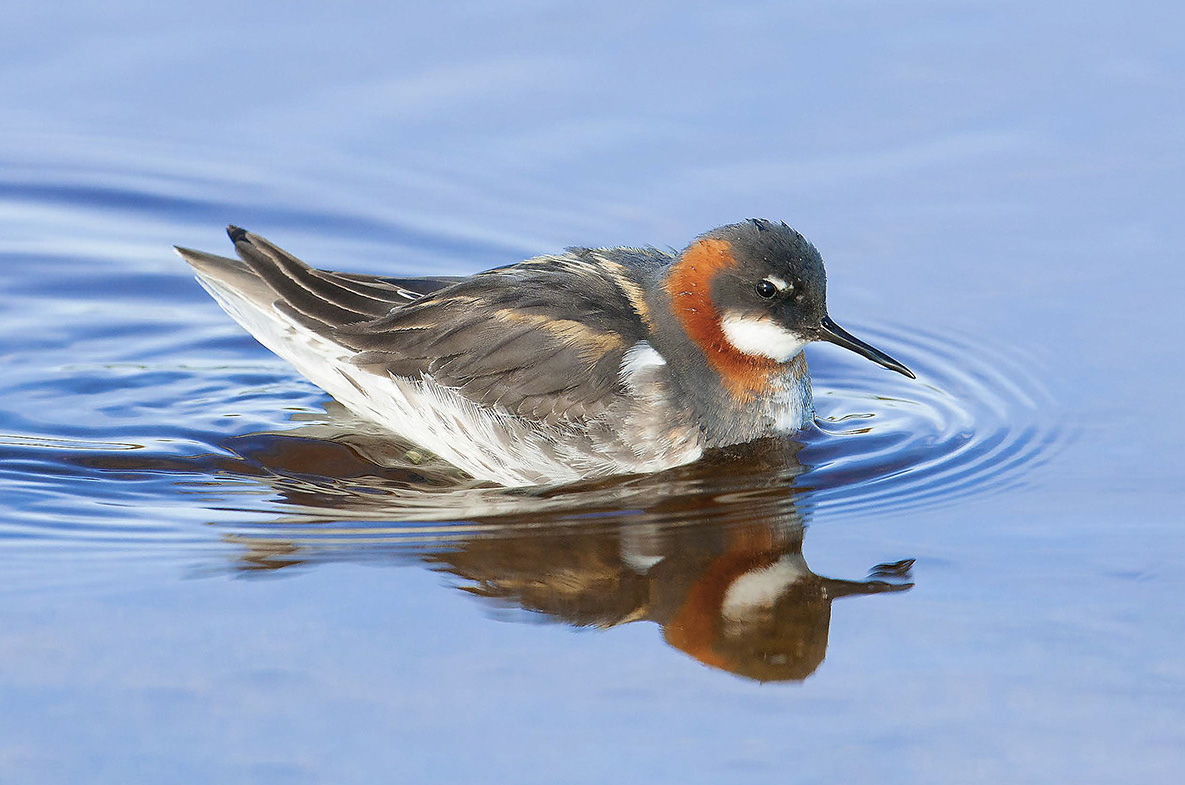
This female, red-necked phalarope is larger and more vibrantly coloured than her male counterpart, as is the case with all phalaropes. The more drab-feathered male builds the nest, incubates the eggs, and raises the young – a complete role reversal from the typical behaviour observed in birds.
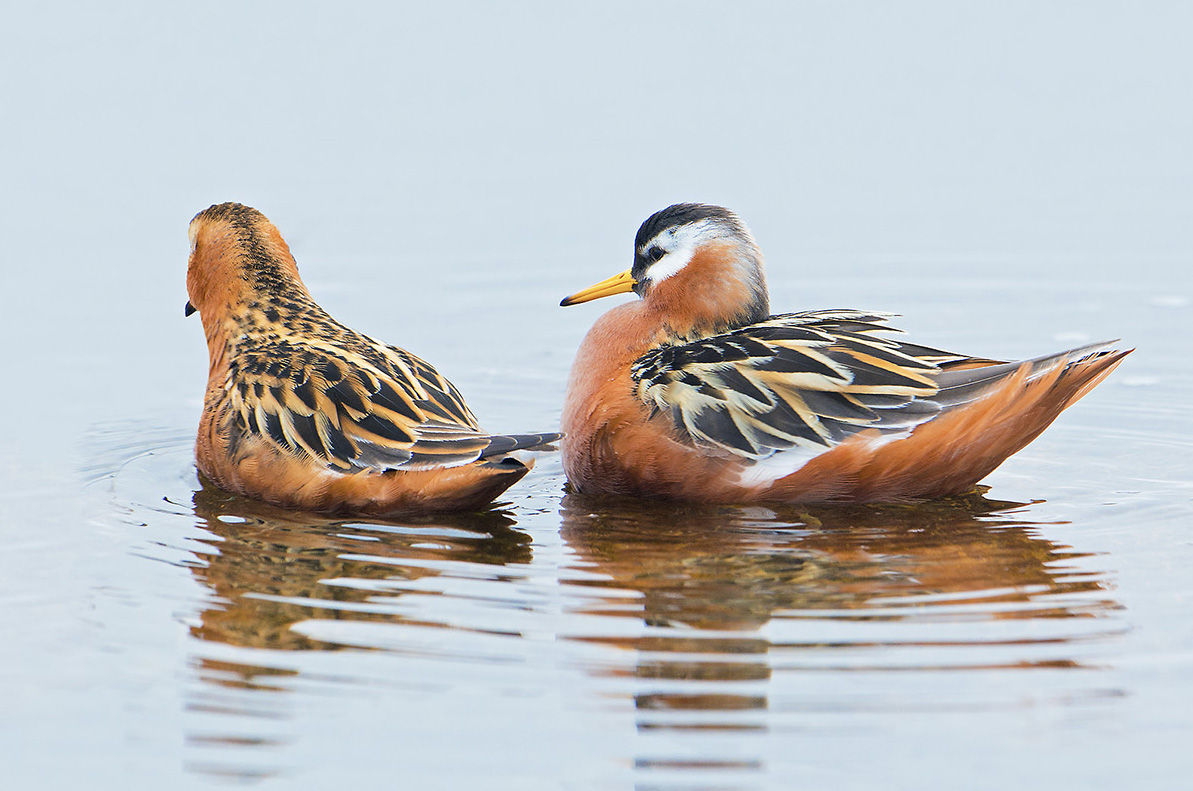
This pair of red phalaropes illustrates the size and plumage differences between the sexes. The female red phalarope on the right is courting the smaller, less brightly patterned male on the left.
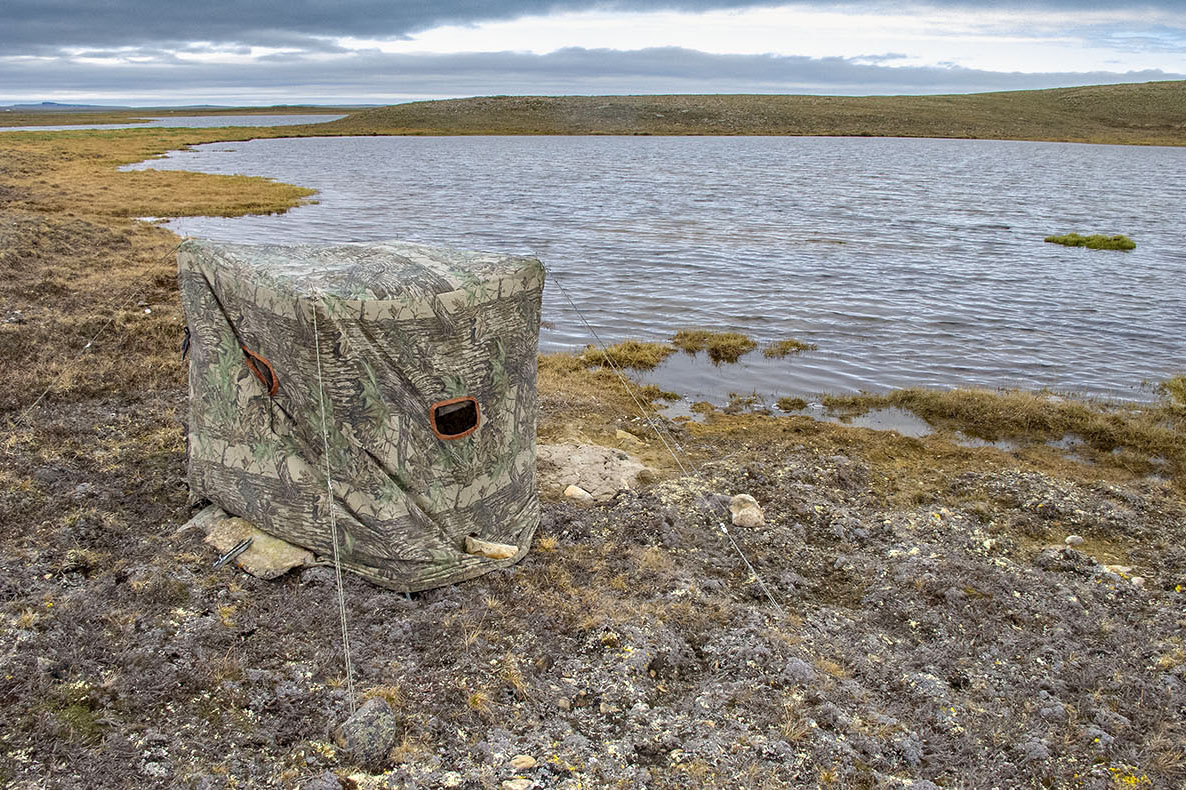
The photo blind is the most crucial piece of equipment I use to photograph birds. Often, it is the only way to observe natural and intimate behaviours. I employed the blind pictured here to observe the red-throated loon nesting on the small grassy mound to the right.
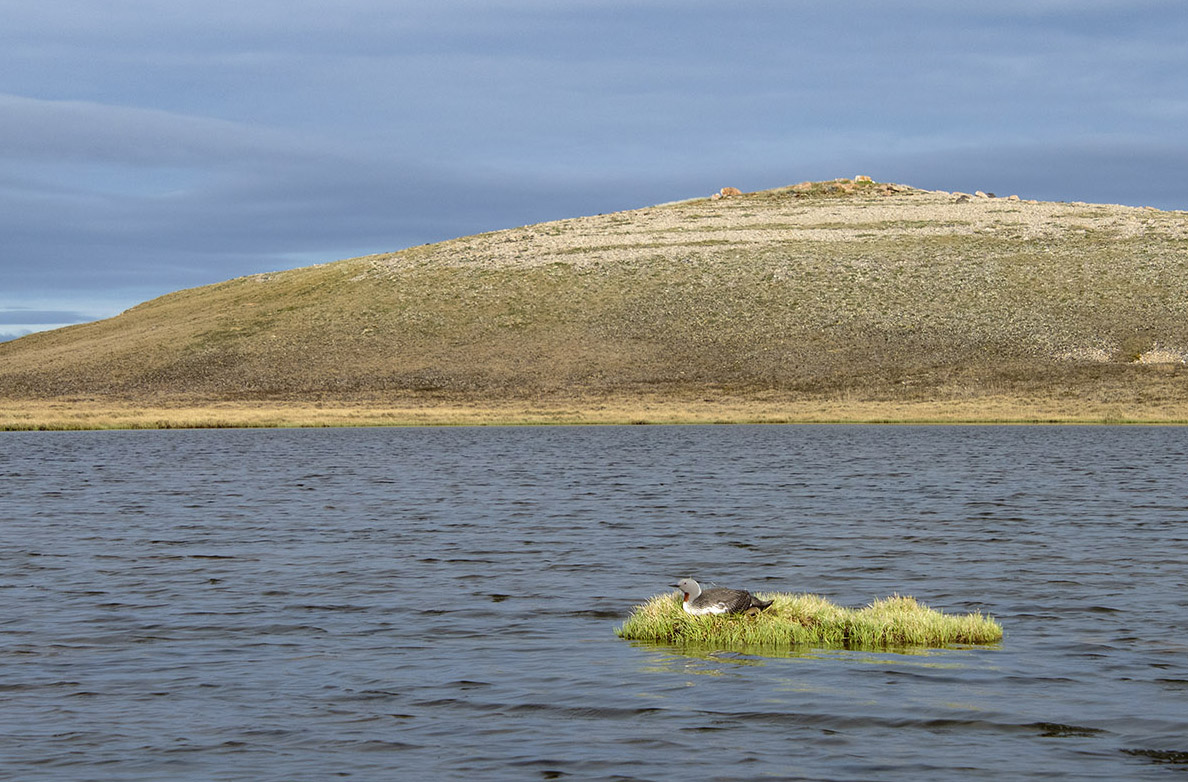
All loons prefer to nest on islands to lessen the threat from mammalian land predators, especially from Arctic foxes in the Arctic.
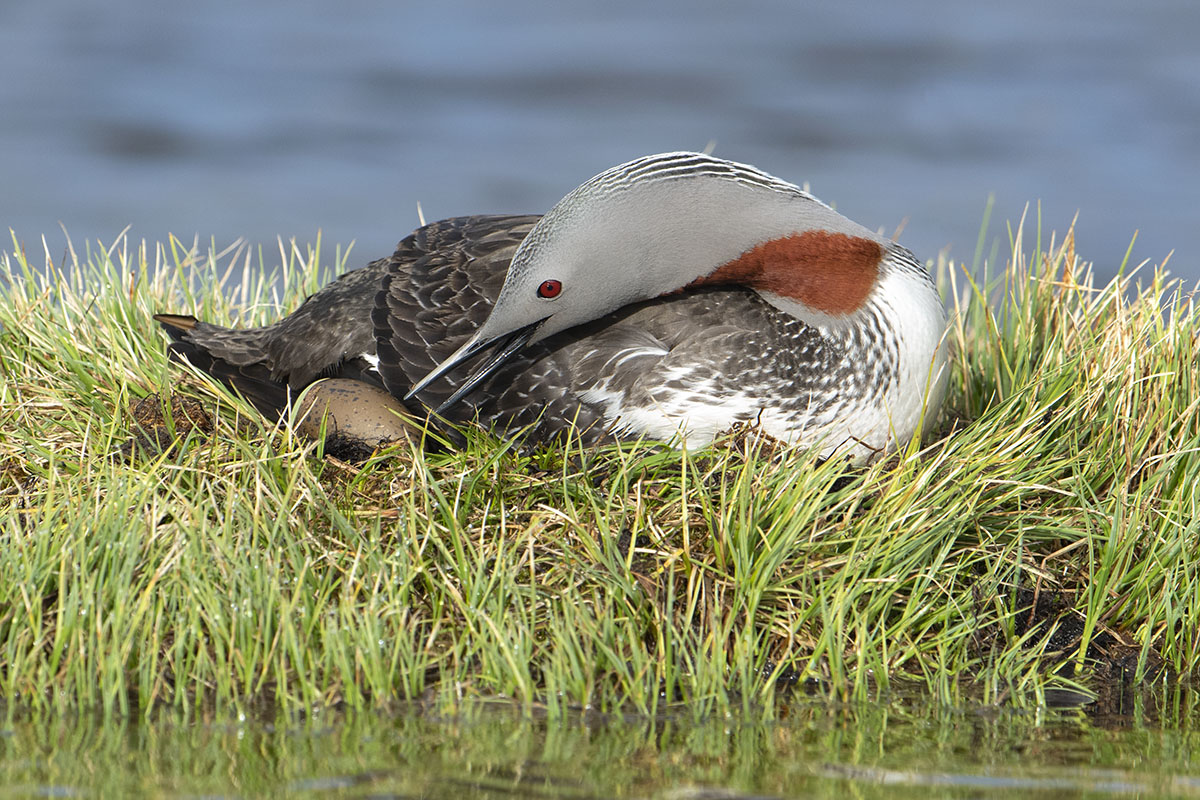
This incubating red-throated loon was sitting on one egg while completely ignoring its second egg. It did this for over two hours.
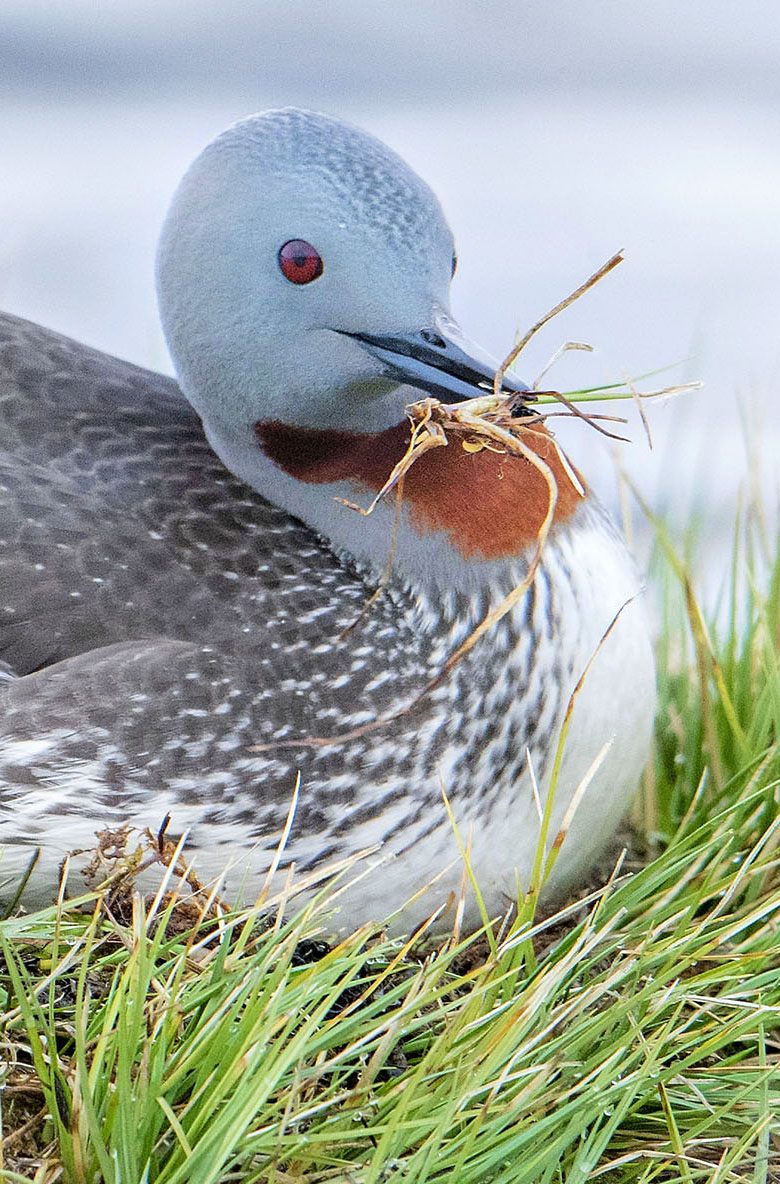
The loon continued to ignore egg #2 even when it plucked grasses from around it.
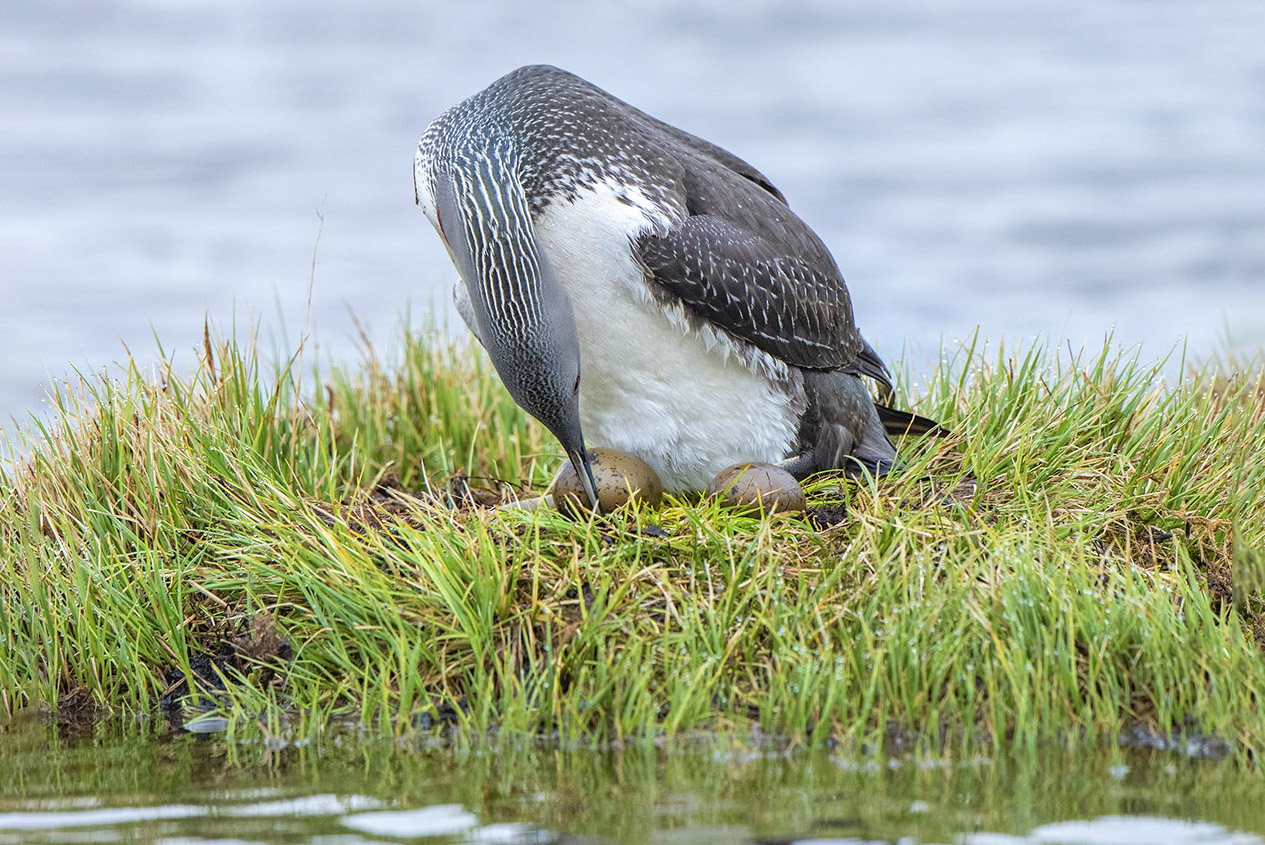
Loons regularly shuffle their eggs every few hours to warm them evenly and prevent embryonic membranes from adhering to the inside of the eggshell.
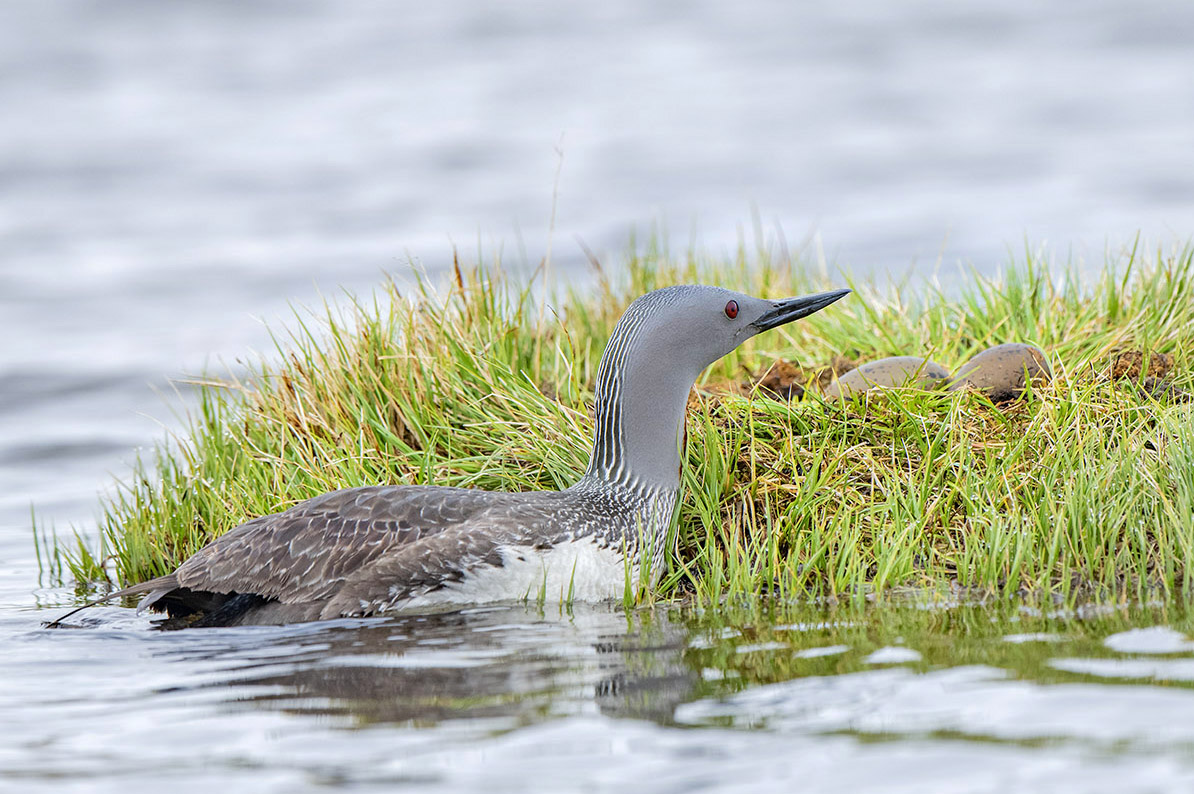
This red-throated loon was relieving its partner and getting ready to mount the nest for an incubation session. The legs on a loon are far towards the rear of its body, so they have difficulty walking, and as a result, it nests very close to the water’s edge.
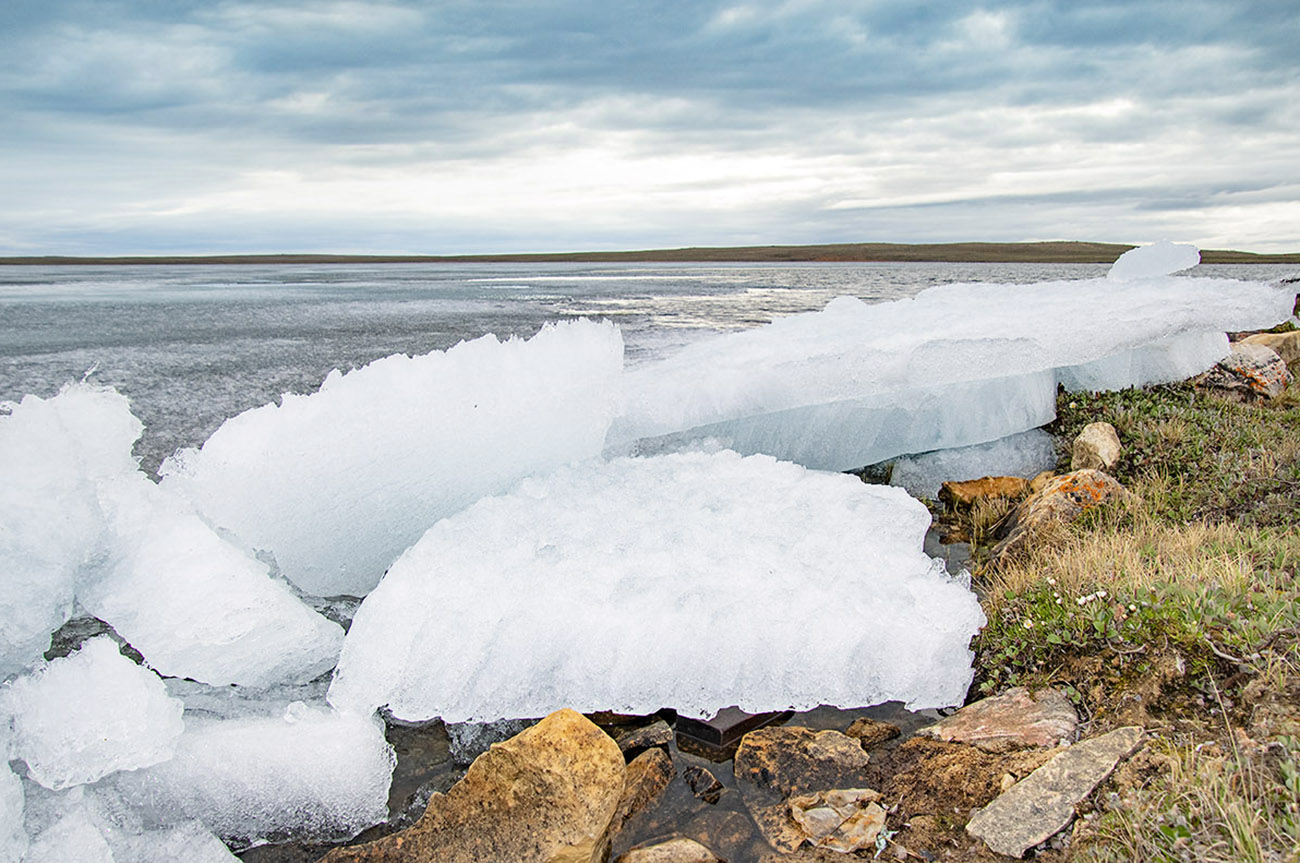
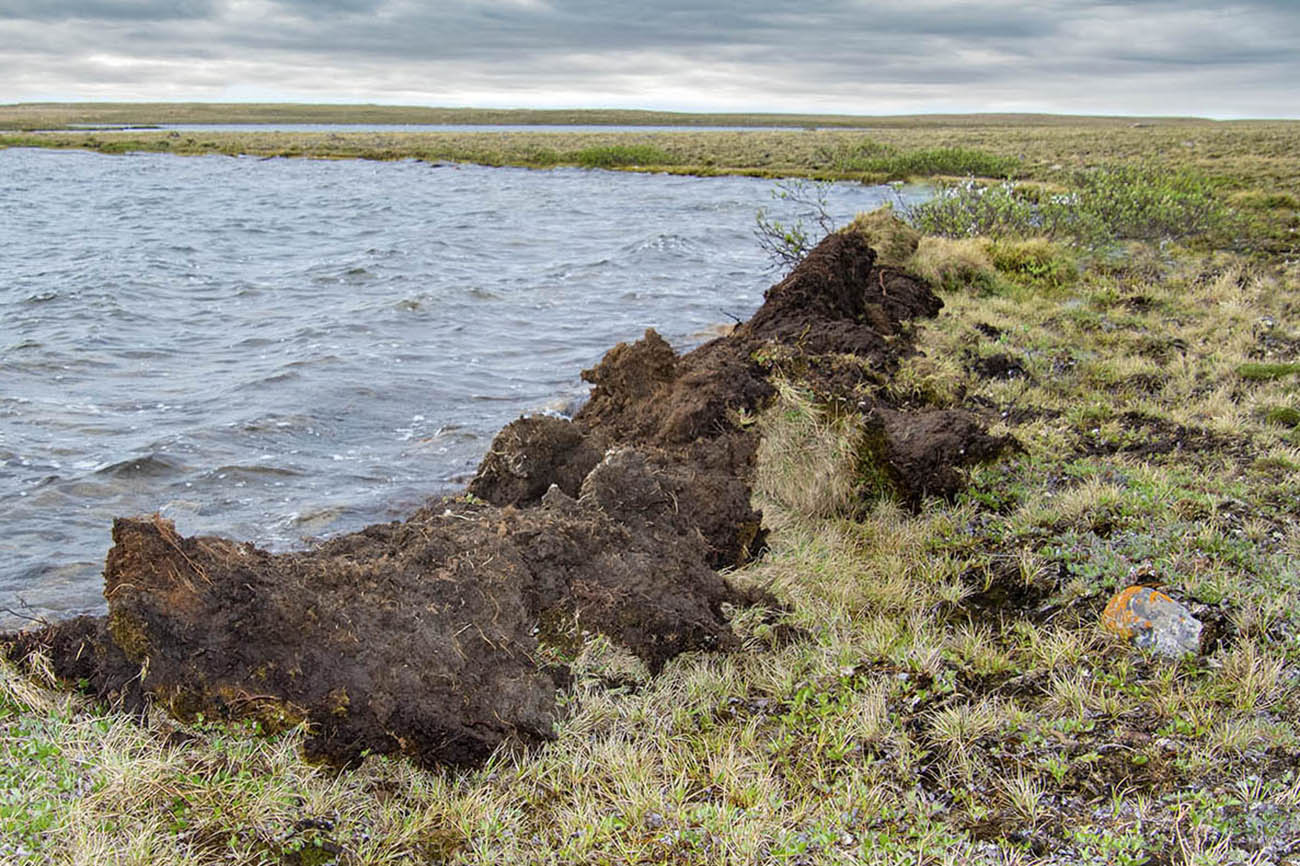
An unexpected threat to a nesting loon in the Arctic is ice that can persist well into the breeding season. In stormy weather, strong winds can drive the ice ashore, scouring the shoreline tundra and destroying any loon nest in its path. When the ice eventually melts, the erosional damage to the shoreline is easily seen.
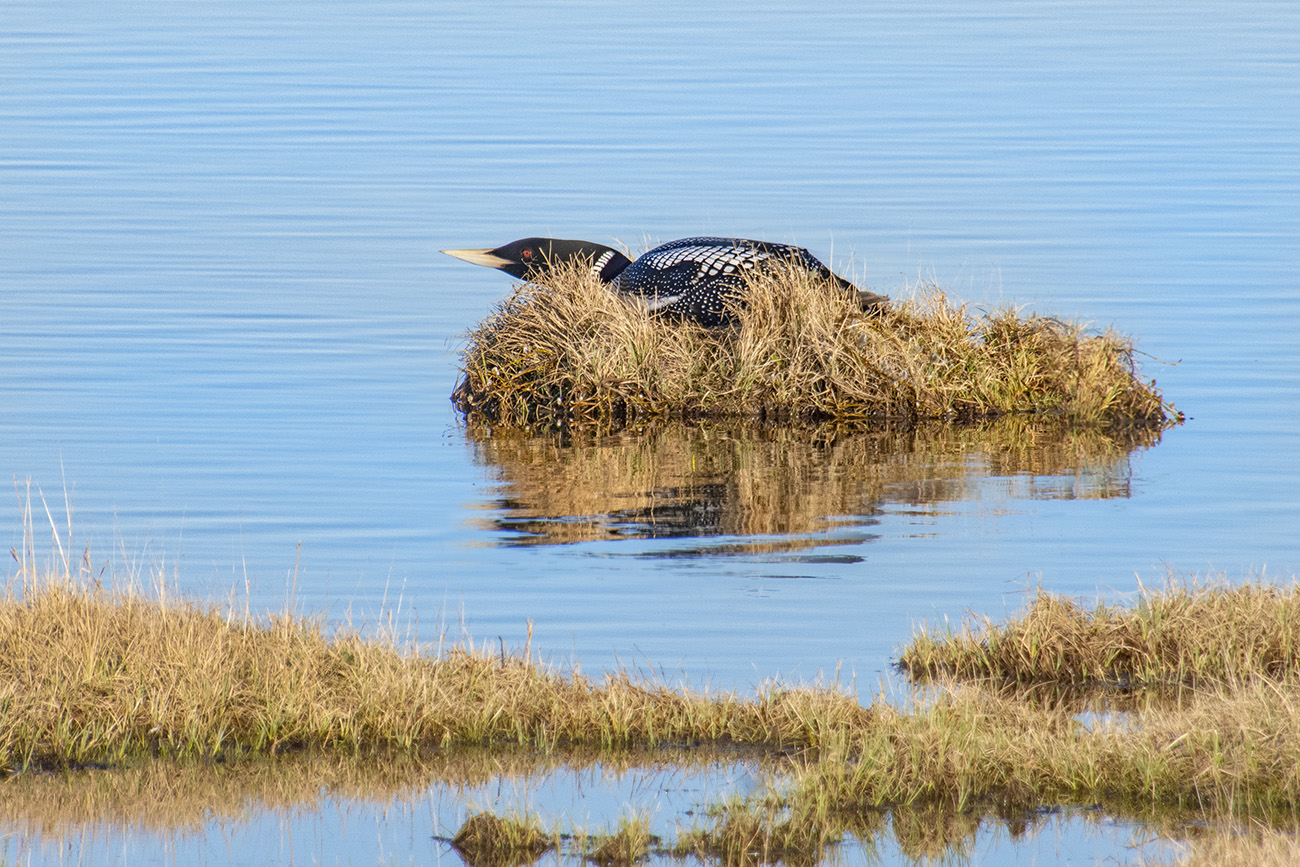
After 20 years of searching, this was the first yellow-billed loon nest I had ever found. The yellow-billed loon is the largest and rarest of the world’s five loon species. Globally, it is a threatened species, numbering fewer than 30,000 in Russia, northern Alaska, and Arctic Canada.
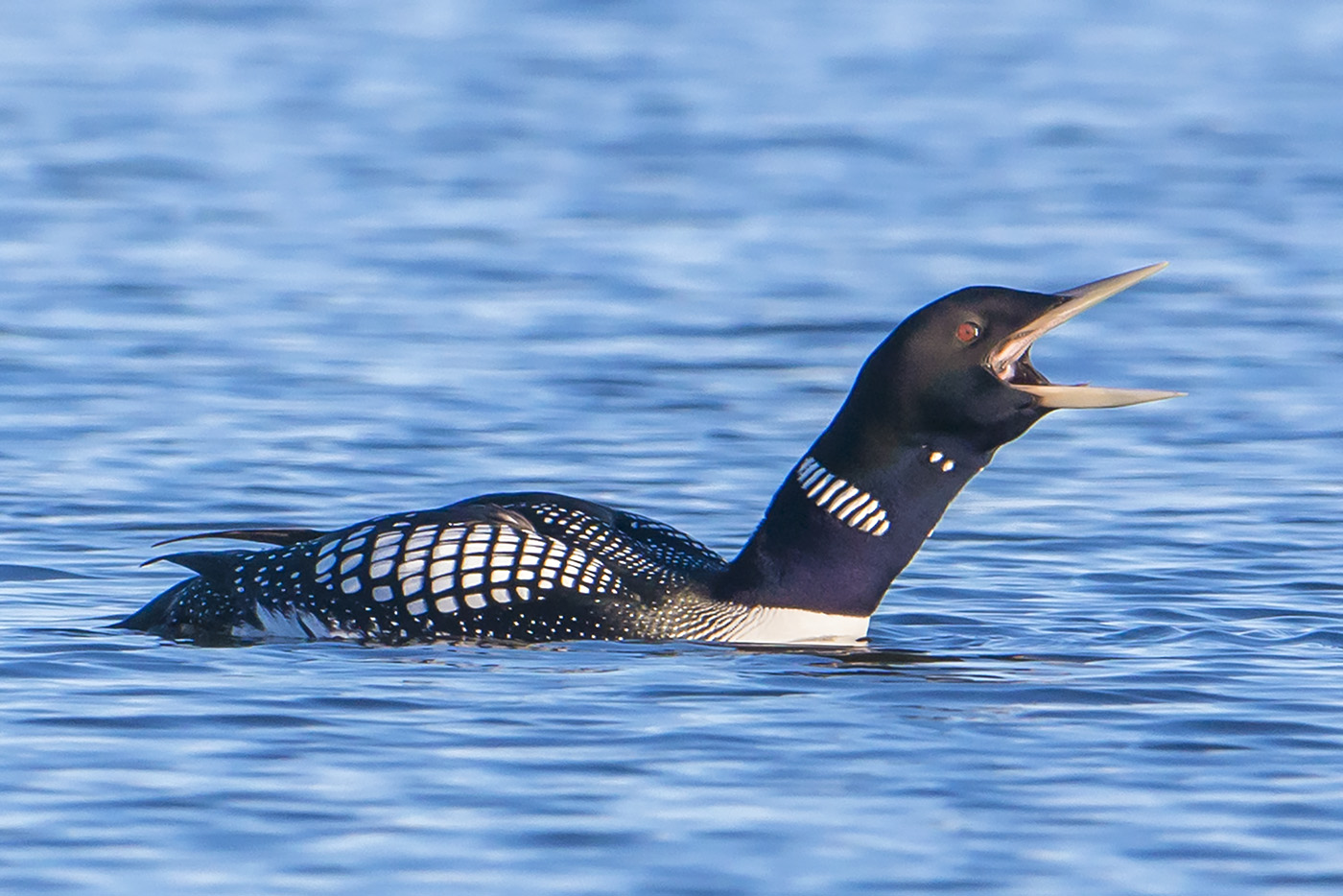
The yodel, given only by male loons, is a proclamation of territorial ownership and a warning to intruders.
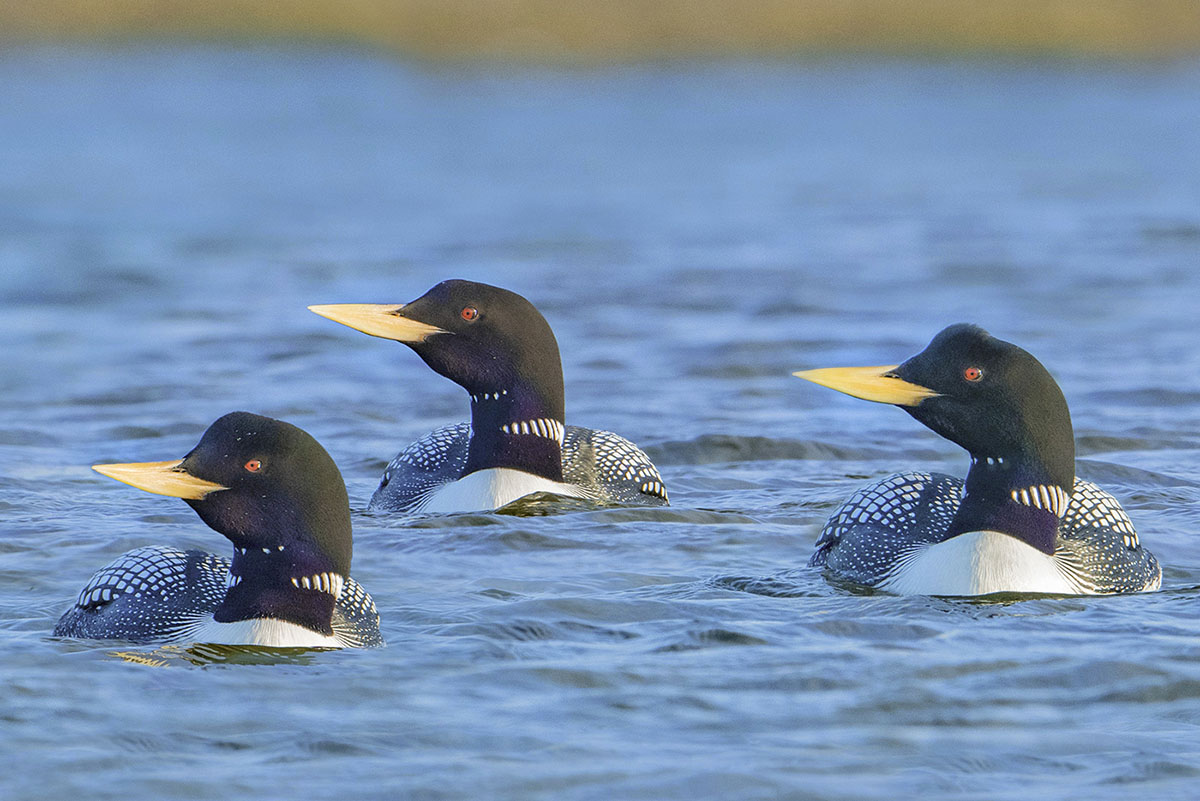
The same trio of loons I had missed a few days earlier because I had no memory card in my camera, thankfully investigated my blind a second time and was rewarded with this photograph.
About the Author – Dr. Wayne Lynch

For more than 40 years, Dr. Wayne Lynch has been writing about and photographing the wildlands of the world from the stark beauty of the Arctic and Antarctic to the lush rainforests of the tropics. Today, he is one of Canada’s best-known and most widely published nature writers and wildlife photographers. His photo credits include hundreds of magazine covers, thousands of calendar shots, and tens of thousands of images published in over 80 countries. He is also the author/photographer of more than 45 books for children as well as over 20 highly acclaimed natural history books for adults including Windswept: A Passionate View of the Prairie Grasslands; Penguins of the World; Bears: Monarchs of the Northern Wilderness; A is for Arctic: Natural Wonders of a Polar World; Wild Birds Across the Prairies; Planet Arctic: Life at the Top of the World; The Great Northern Kingdom: Life in the Boreal Forest; Owls of the United States and Canada: A Complete Guide to their Biology and Behavior; Penguins: The World’s Coolest Birds; Galapagos: A Traveler’s Introduction; A Celebration of Prairie Birds; and Bears of the North: A Year Inside Their Worlds. In 2022, he released Wildlife of the Rockies for Kids, and Loons: Treasured Symbols of the North. His books have won multiple awards and have been described as “a magical combination of words and images.”
Dr. Lynch has observed and photographed wildlife in over 70 countries and is a Fellow of the internationally recognized Explorers Club, headquartered in New York City. A Fellow is someone who has actively participated in exploration or has substantially enlarged the scope of human knowledge through scientific achievements and published reports, books, and articles. In 1997, Dr. Lynch was elected as a Fellow to the Arctic Institute of North America in recognition of his contributions to the knowledge of polar and subpolar regions. And since 1996 his biography has been included in Canada’s Who’s Who.



Great article and pictures.
This is another great set of photos and clear ,concise descriptions of the birds and their surrounding. Totally enjoyed the whole story, Very well done.
Thanks Marilyn & Len. I was in Brazil until this morning so I apologize for my delay in answering. I am very happy that you appreciate nature as I do.
Wayne